This page is part of our series on how 3D rendering works, explained in plain terms. It shows one building in six rendering styles, defines each style, and gives a stage-by-stage rule for choosing one, followed by the types of architectural rendering, the techniques behind the styles, common mistakes, what the right style does for a project, and how long a rendering takes.
What are the different types of rendering styles?
The main rendering styles are photoreal, clay or white model, gray render, collage, sketch or watercolor, and stylized or cel-shaded. These 3D rendering styles apply to every kind of rendering in architecture, exterior or interior, still or animated. Architecture render styles differ in how much they commit to: a photoreal image fixes every material and light, while a sketch leaves the design open. That is the real difference between architecture rendering styles and the reason architectural visualization styles are chosen by stage. When people search for types of renders, they usually mean these looks rather than the software behind them.
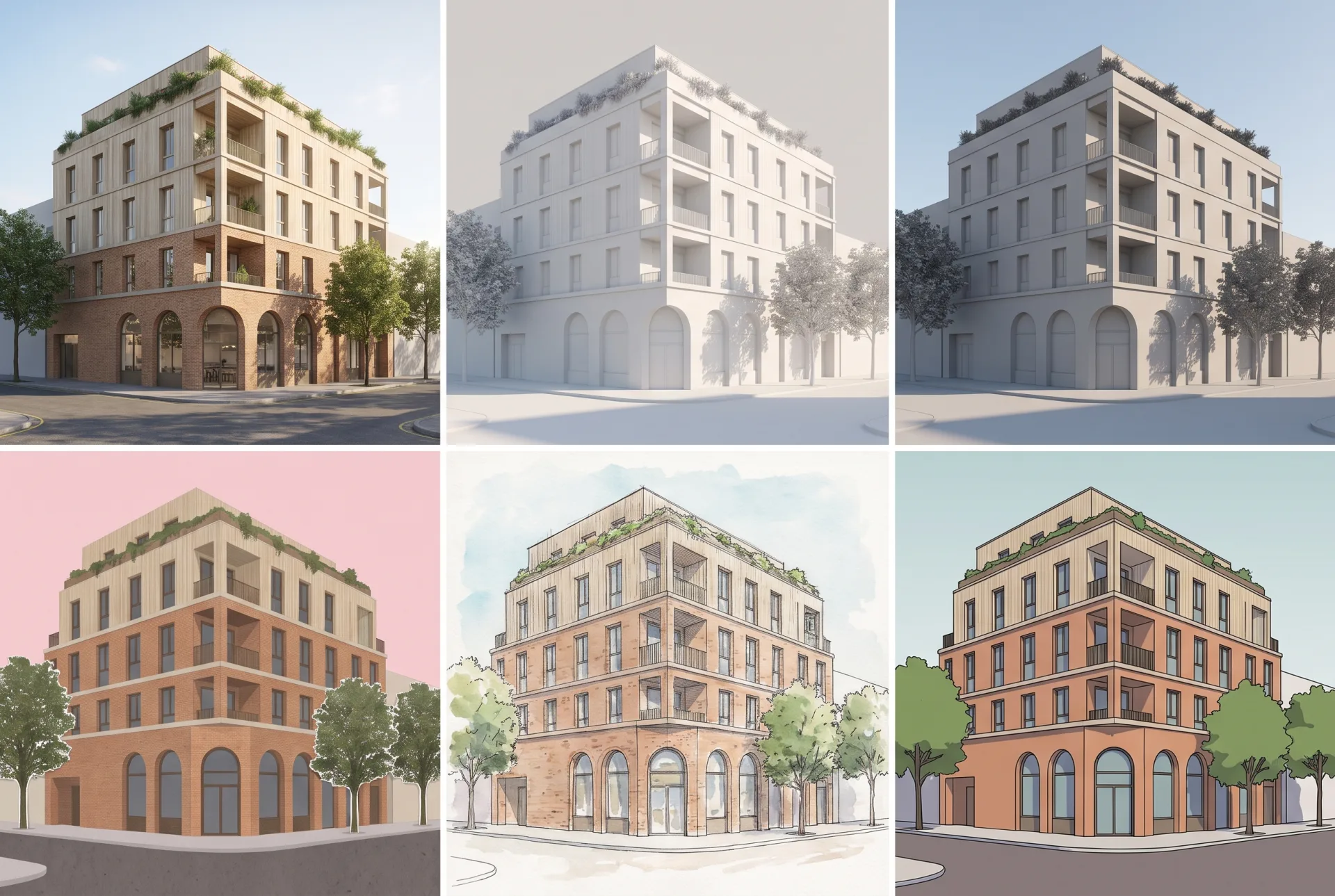
| Style | What it looks like | Best for | Typical stage |
|---|---|---|---|
| Photoreal | Reads as a photograph of the finished building; see what makes a realistic render convincing | Planning, sales, marketing | Planning to pre-sales |
| Clay or white model | The whole model in one plain white material, with real light and shadow | Massing, form, daylight studies | Concept to design development |
| Gray render | Clay-style image in mid-gray | Checking light and camera before materials | Any stage, as a draft |
| Collage | Flat cut-out textures, figures and sky over a simple 3D view | Competitions, concept presentations | Concept and competition |
| Sketch or watercolor | Line work with loose washes of color | Early client meetings, heritage projects | Concept |
| Stylized or cel-shaded | Simplified flat colors and outlines, like an illustration or cartoon | Explainer graphics, campaigns, public consultation | Any stage, for a specific audience |
What is a clay render?
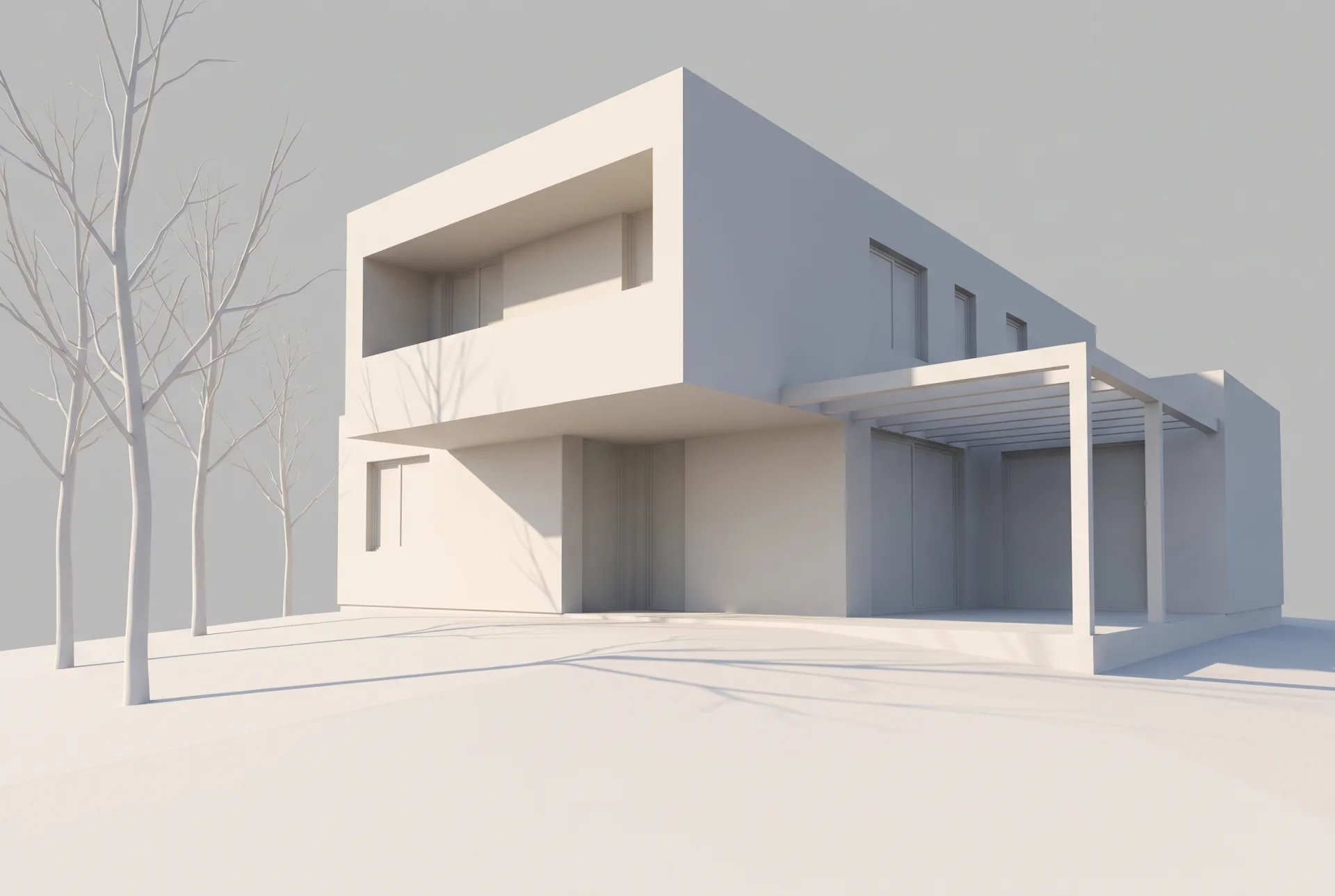
A clay render shows a model in one plain material, usually white or light gray, so form, massing and light are judged without colors or textures. Clay rendering strips away every decision about finishes and leaves only shape and shadow, which is why architects use it to test proportions and how sunlight falls on a facade. It is also the first draft in our own process at 3DRenderingAgency: every view we render is shown in clay first, so camera and massing are agreed before materials go on.
What is a gray render?
A gray render is a clay-style image in mid-gray used to check lighting and composition before materials are applied. It is the most common form of monochrome rendering. A mid-gray surface shows exposure problems better than white: if the gray looks muddy, the scene is too dark; if it looks pale, the light is too strong. Artists often render a gray version of a finished scene too, overriding every material with one gray, to check whether a problem lies in the lighting or in a material. Unlike a white clay render, a gray render is rarely shown to a client as a final image.
What is a collage rendering?
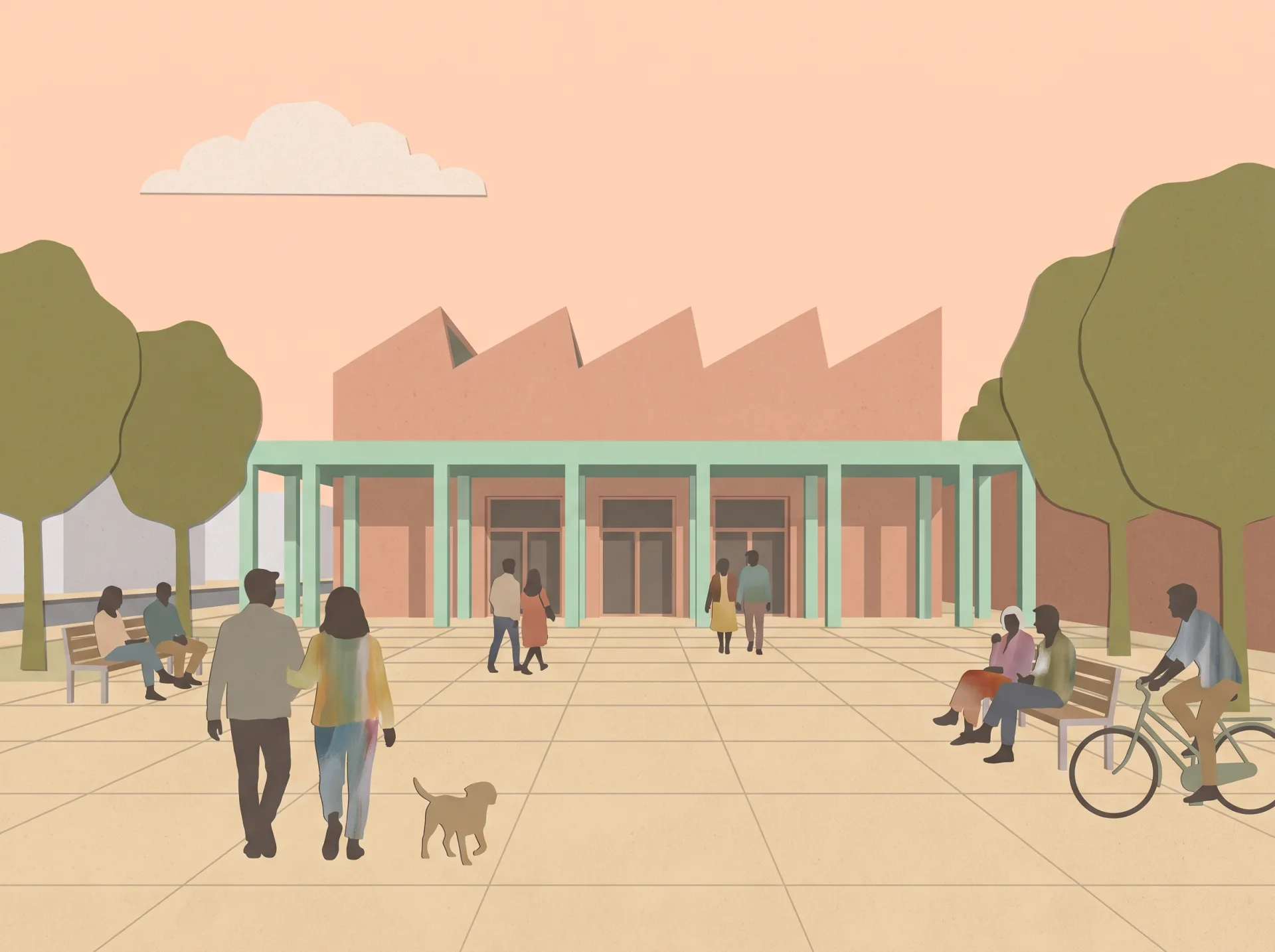
A collage rendering combines a simple 3D view with flat cut-out textures, people and sky in a graphic, posterized style, popular in competitions. The 3D model supplies the perspective; everything else is layered on in Photoshop: paper-flat trees, figures cut from paintings or photographs, skies in a single pastel tone. The style signals ideas rather than finishes, so a jury or client reads it as a proposal, not a promise of exact materials.
What is MIR-style rendering?
MIR-style rendering refers to the moody, atmospheric photoreal look associated with the Norwegian studio MIR, with soft light, mist and muted color. MIR is a Bergen-based visualization studio founded in 2000 by Trond Greve Andersen and Mats Andersen, and Architizer describes the MIR style as a phrase 3D artists use for images dominated by rich atmosphere and evocative natural settings. When a client asks for MIR rendering, they usually mean low light, weather, a landscape that matters as much as the building, and restrained color. It is a mood of photoreal, not a separate technique, and it suits cultural buildings and houses in dramatic landscapes better than a suburban sales brochure.
What is a stylized 3D render?
A stylized 3D render simplifies color, light and detail on purpose, from cel-shaded cartoon looks to illustration styles. Stylized 3D images are made from the same model as a photoreal one, but with shaders that draw flat bands of color and outlines instead of physical light. They are a branch of non-photorealistic rendering, and they work well for public consultation boards and campaign graphics, where a friendly picture explains a project better than a photograph would.
Which rendering style suits which project stage?
Clay and sketch styles suit concept design, collage suits competitions, and photoreal suits planning, sales and marketing. Put more precisely, loose styles (sketch, watercolor, collage) suit concept and competition stages, clay and diagrammatic suit design development and planning, and photoreal suits pre-sales and marketing. Early-stage styles are delivered through our conceptual rendering service.
| Project stage | Recommended style | Why |
|---|---|---|
| Concept and feasibility | Sketch, watercolor or clay | Shows the idea without fixing finishes that will change |
| Competition | Collage or watercolor | Communicates an idea and an atmosphere quickly to a jury |
| Design development | Clay or diagrammatic | Tests form, daylight and how the parts fit, without distraction |
| Planning submission | Photoreal, or clay for massing studies | Shows the building honestly in its real context |
| Pre-sales and marketing | Photoreal | Buyers need to see the finished product |
| Public consultation | Stylized or photoreal | Clear, friendly images for a non-specialist audience |
How do you choose a style for your architectural rendering brief?
Choose the style by who will see the image and what decision it must support, then name it in the brief with a reference image. A planning officer needs to judge the building honestly; a buyer needs to want to live in it; a competition jury needs to grasp an idea in seconds. Words like moody or clean mean different things to different people, so attach one or two reference images and say what you like about each: the light, the color, the level of detail. Our architectural visualization brief template lists everything else to include. Whatever the style, our architectural rendering starts from your drawings and shows a clay draft before the style is applied.
What are the different types of architectural renderings?
The main types of architectural rendering are exterior, interior, aerial, floor plan, elevation and section renderings, animations and virtual tours, each available in different styles. Type is what the image shows; style is how it looks. A watercolor aerial and a photoreal aerial are the same type in two styles.
| Type | What it shows | Service |
|---|---|---|
| Exterior | The building at eye level in its street or landscape | Exterior rendering services |
| Interior | One room from one camera, with finishes and light | 3D interior rendering |
| Aerial | The building and site from above | Aerial architectural rendering |
| Floor plan | A furnished plan seen from above | 3D floor plans |
| Elevation and section | A flat facade or cut through the building, in color | Elevation rendering |
| Animation | A camera moving through or around the project | Flythroughs |
| Virtual tour | 360 panoramas the viewer can turn and move between | 3D home tours |
What are the main architectural rendering styles?
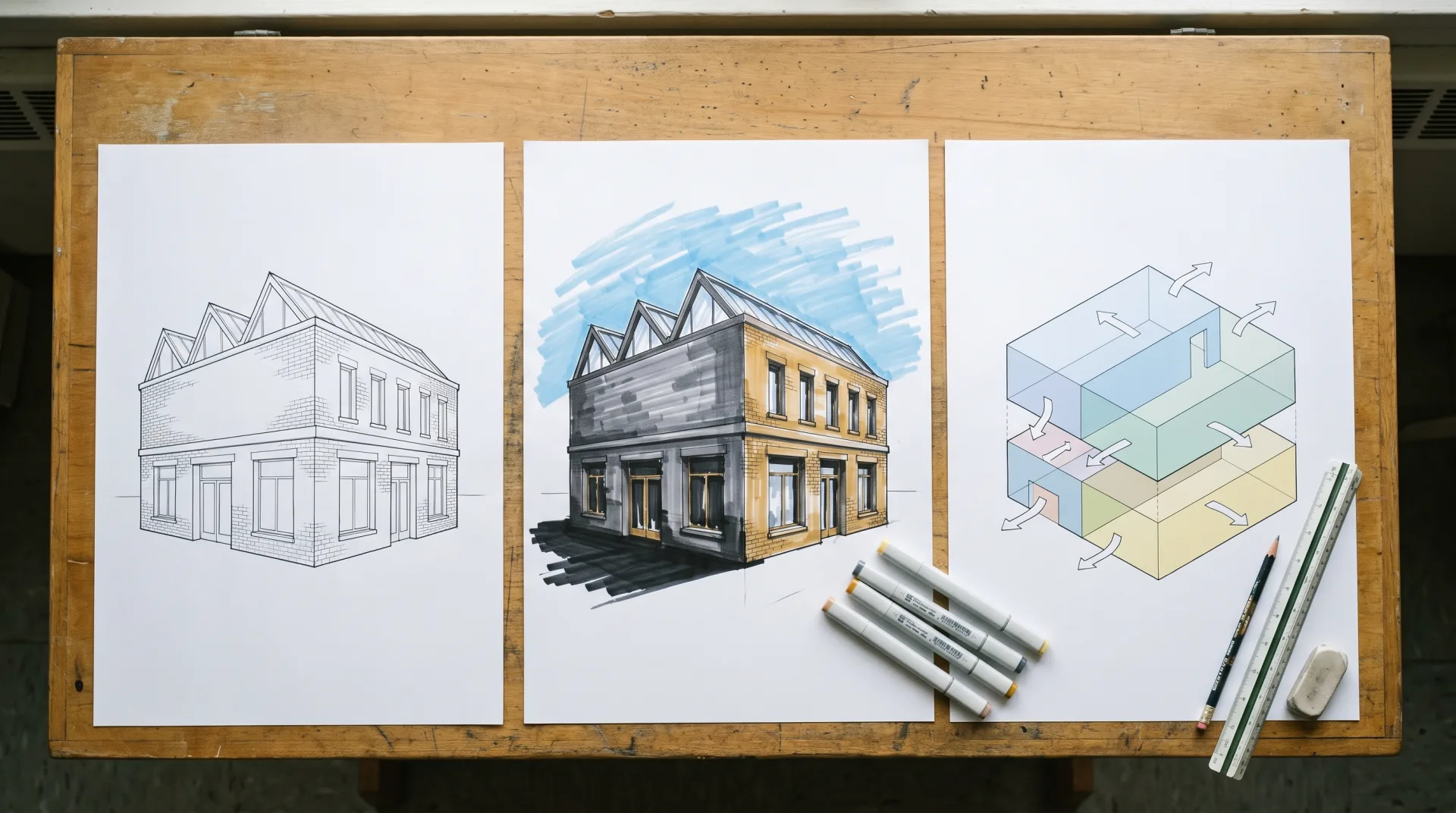
The main styles are photoreal, watercolor, sketch or line, marker, collage, clay or white model, diagrammatic, and stylized (NPR) renders. Most of these architectural rendering styles are shown in the grid above; three more come from drawing traditions. Line renders show the building as clean outlines only, often over a white background. Marker renders imitate the felt-tip presentation drawings architects made by hand, with bold strokes and strong shadows. Diagrammatic renders use flat colors to explain how a building works, such as which floors are homes and which are shops, or how air moves through it.
What is watercolor architectural rendering?
Watercolor architectural rendering presents a building in soft washes of color over line work, either painted by hand or produced digitally from a 3D model, and suits early concepts, heritage projects and competitions. Watercolor rendering made from a model keeps the perspective accurate while the washes keep the mood loose, which tells the viewer the design is still being shaped. It also sits well beside historic buildings, where a hard photoreal image of a new addition can feel more intrusive than the building will.
What are the different types of rendering techniques?
The rendering techniques behind these styles are photoreal path tracing, real-time rendering, non-photorealistic shaders, hand drawing and Photoshop collage. Several styles can come from more than one technique: a watercolor can be painted by hand or produced by a shader, and a clay render can come from a path tracer or a real-time engine.
| Technique | How it works | Styles it produces |
|---|---|---|
| Path tracing | Follows light through many bounces for physically accurate images | Photoreal, clay, gray, MIR-style atmosphere |
| Real-time rendering | Draws images fast enough to move through, approximating light | Near-photoreal walkthroughs, clay previews |
| Non-photorealistic shaders | Replace physical light with outlines, flat color or painterly strokes | Stylized, cel-shaded, digital watercolor and line |
| Hand drawing | Pencil, ink, marker or watercolor on paper, often traced over a 3D view | Sketch, marker, watercolor |
| Photoshop collage | Layers flat textures, cut-out figures and skies over a simple 3D view | Collage |
What are common house rendering mistakes?
The most common house rendering mistakes are choosing photoreal too early, wrong scale, too wide a lens, flat lighting and mismatched entourage.
- Photoreal too early. A photoreal image of a house whose windows and finishes are still undecided invites comments on details instead of the design, and every change costs a re-render.
- Wrong scale. Doors, steps and railings that are slightly too big make a house look like a model; the eye knows their real size.
- Too wide a lens. An ultra-wide view stretches the front yard and makes the house look small and distant.
- Flat lighting. Light from directly behind the camera removes the shadows that show depth in a facade.
- Mismatched entourage. People, cars and plants that do not fit the climate, the season or the buyers the house is for make the image less believable.
What does choosing the right rendering style do for your project?
Choosing the right rendering style keeps every review focused on the decision in front of it: abstract styles for massing and layout, photoreal for finishes and marketing. A clay or collage image at concept stage lets a client or review panel judge form and context without debating tile colors that are not chosen yet, so the design moves forward in fewer rounds. A photoreal image at marketing stage shows buyers and investors a home or tower before it exists, so units can be marketed and sold off-plan. Because our designers know how a building goes together and read plans, sections and finish schedules correctly the first time, each style reaches you with fewer corrections. Conceptual images in sketch, watercolor or collage styles are quoted on the brief, from the sketch or massing model you send, and every quote is fixed within 12 hours of receiving your files. Rates for each image type are on our 3D rendering prices page.
How long does a rendering take?
A rendering takes from a few days for a single still to several weeks for an animation, depending on style, model readiness and revisions. Our first draft of a still arrives in 3 to 5 business days, and of an animation in 2 to 3 weeks. Two revision rounds are included, and finished stills arrive as 4K JPG and PNG files with full commercial rights, ready for print, web and listings.