Both methods follow rays of light; they differ in how far they follow them. Our page on path tracing explains that method in full. This page puts the two side by side on one interior, shows what changes in the picture, and maps each method to the images and tours an architect or developer actually buys.
What is the difference between path tracing and ray tracing?
Path tracing traces every bounce of light for every pixel, while hybrid ray tracing traces only chosen effects and rasterizes the rest. Asked as ray tracing vs path tracing, the question is really about scope. The meaning of ray tracing is broader: it is the umbrella technique of following lines of light through a scene. A game with "ray tracing on" usually draws the image the fast, rasterized way and then traces rays for reflections, shadows or a single bounce of light. A path tracer traces everything: each ray keeps bouncing in a random direction, picking up color from each surface, until it reaches a light or runs out of energy, and thousands of these paths are averaged per pixel.
The idea goes back to 1986, when Jim Kajiya introduced path tracing with his paper on the rendering equation, according to the Wikipedia article on path tracing. The same article notes that because path tracing uses random samples, the image starts noisy and the noise falls as more samples are taken.
| Aspect | Hybrid ray tracing | Path tracing |
|---|---|---|
| What it traces | Selected effects: reflections, shadows, sometimes one bounce of light. The rest is rasterized. | All light in the scene, direct and indirect, for every pixel |
| Bounces | Usually one, sometimes two | Many, until the path reaches a light or fades out |
| Global illumination | Approximated, or traced at low quality | Full global illumination by design |
| Noise | Low ray counts, cleaned by a denoiser | Grainy at first, clears with more samples per pixel, then denoised |
| Speed | Real time: tens of frames per second on a recent GPU | Offline: minutes to hours per high-resolution still; real time only on top hardware with heavy upscaling |
| Typical use | Games, real-time design review, interactive walkthroughs | Film, architectural and product stills, animation frames |
| Example engines | Game engines, Unreal Engine with Lumen | Corona, V-Ray, Blender Cycles |
What do path tracing and ray tracing look like side by side?
Side by side, the path-traced image shows color bleeding, softer contact shadows and evenly lit corners that the hybrid ray-traced image lacks. In the living room below, both halves have the same model, materials, sun and camera. Only the light calculation differs.
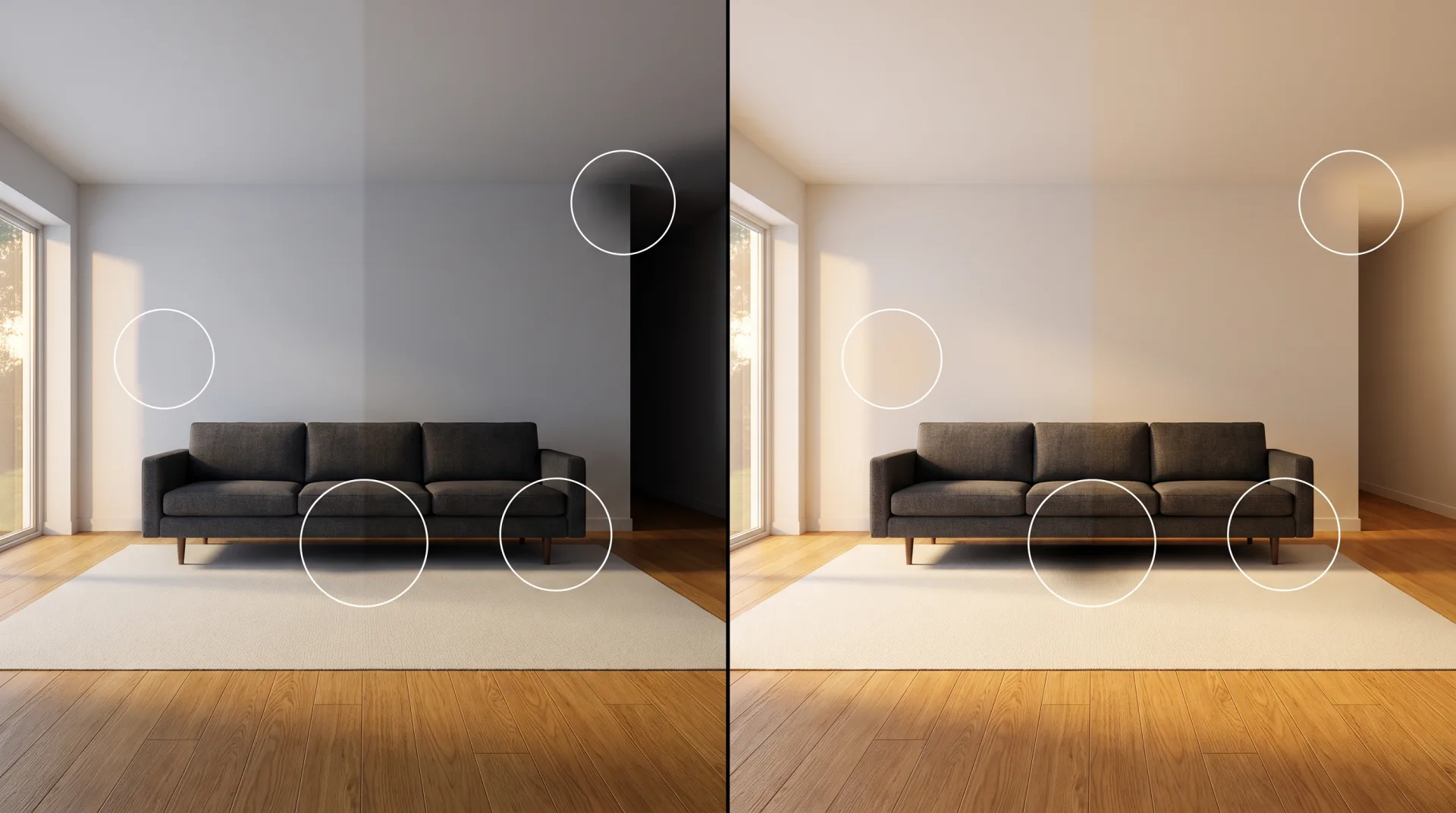
- The wall above the oak floor. In the path-traced half, sun bouncing off the floor tints the white wall a warm honey color. The hybrid half leaves it cold gray. That extra light bounce is global illumination.
- The shadow under the sofa. Path tracing gives a dense dark line where the sofa meets the rug, fading softly outward. The hybrid half shows a uniform smudge.
- The ceiling corner farthest from the window. Path tracing lights it with light bounced several times around the room. In the hybrid half it falls almost to black.
Those three spots are what a client notices without knowing why. A room that looks cold, flat or too dark in the corners is usually short of bounced light, not short of lamps.
Is path tracing worth it?
For a still image that will sell or win approval for a building, path tracing is worth the extra render time; in games it is worth it only on hardware fast enough to keep the frame rate playable. A marketing still is rendered once and seen for months, in brochures, listings and planning packs, so a few extra hours of computer time cost little against an image that reads as a photograph. In a game the cost is paid every frame. If path tracing drops the game below a smooth frame rate, most players get more from a lighter mode.
Does path tracing reduce FPS?
Path tracing reduces frames per second sharply, so real-time path tracing depends on upscaling and denoising to stay playable. A path tracer needs many rays per pixel to give a clean image, and a game has only a few milliseconds per frame. Real-time path tracers therefore trace very few rays, render at a lower resolution, clean the grain with denoising and let an AI upscaler fill in the missing pixels. Without those helpers, even top graphics cards fall to a frame rate few people would play at.
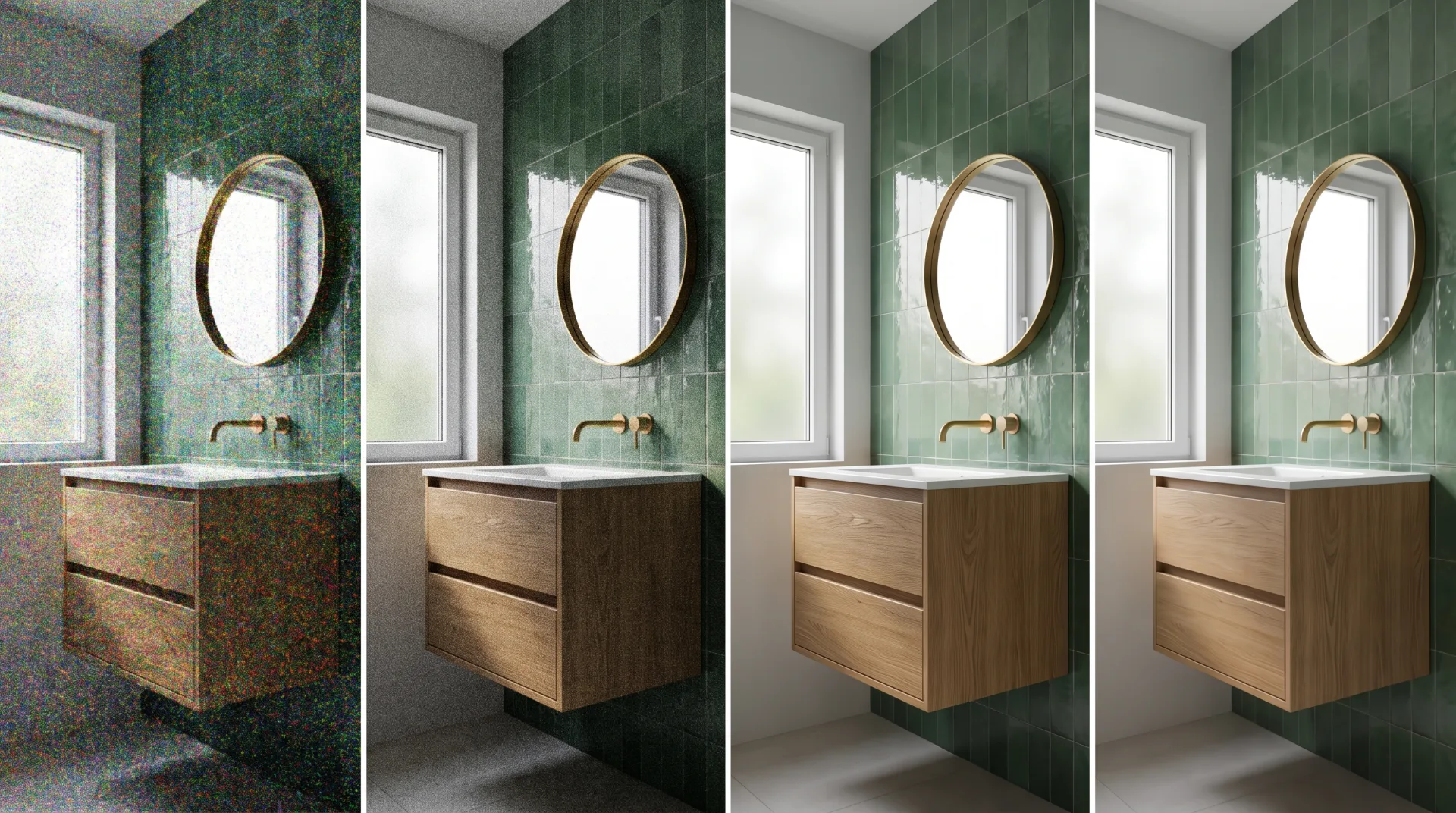
The strip above shows why. The same bathroom is path traced with very few samples per pixel, then more, then many, and finally with few samples plus a denoiser. A game gets roughly the first strip's budget each frame; our stills get the third strip's, then a light denoise.
Does Cyberpunk 2077 use path tracing or ray tracing?
Cyberpunk 2077 offers both: ray-traced lighting modes and a full path-traced mode called Ray Tracing: Overdrive, added in 2023. The developer released it as a technology preview in patch 1.62 on April 11, 2023, describing it as a fully ray-traced, or path-traced, rendering mode, according to CD PROJEKT RED's patch notes.
Which GPUs can do path tracing?
Any modern GPU can run an offline path tracer, but real-time path tracing in games needs a recent high-end card with dedicated ray tracing hardware. For the Overdrive preview, the same patch notes recommended an NVIDIA GeForce RTX 40 Series card from the 4070 Ti up, or an RTX 3090 at 1080p and 30 frames per second. For rendering work rather than games, see our page on the GPU and computer for rendering.
Which does the agency use for stills and for walkthroughs?
We path trace final stills, animation frames and 360 panoramas in offline engines, and use Unreal Engine 5 only where a viewer must move freely, as in a VR walkthrough, with Lumen lighting that keeps it close to our stills. Corona and V-Ray inside 3ds Max are the main production renderers at 3DRenderingAgency, where designers who know how a building goes together render every view, with Blender's Cycles for some scenes.
| Deliverable | Method | Engine | Why |
|---|---|---|---|
| Still image (interior, exterior, aerial) | Path tracing, offline | Corona or V-Ray in 3ds Max; Cycles for some scenes | Rendered once and viewed for months, so accuracy outweighs render time |
| Architectural animation | Path tracing, offline, frame by frame | Corona or V-Ray | Every frame should match the stills; the render runs over the 2 to 3 weeks of production |
| Virtual tour | Path-traced 360 panoramas | Corona or V-Ray | Each panorama is a fixed viewpoint, so it can carry full bounced light |
| VR walkthrough | Real-time hybrid ray tracing | Unreal Engine 5, with Lumen lighting | The viewer moves freely, so frames must draw in milliseconds |
Our architectural 3D animation is rendered from the same scenes as the stills, so the film and the images match, with a first draft in 2 to 3 weeks. Our real estate virtual tours are built from rendered panoramas, so every view a buyer turns to keeps full traced light. For still images, every architectural render we make is path traced, so investors and planning boards see light and materials as they will be built.