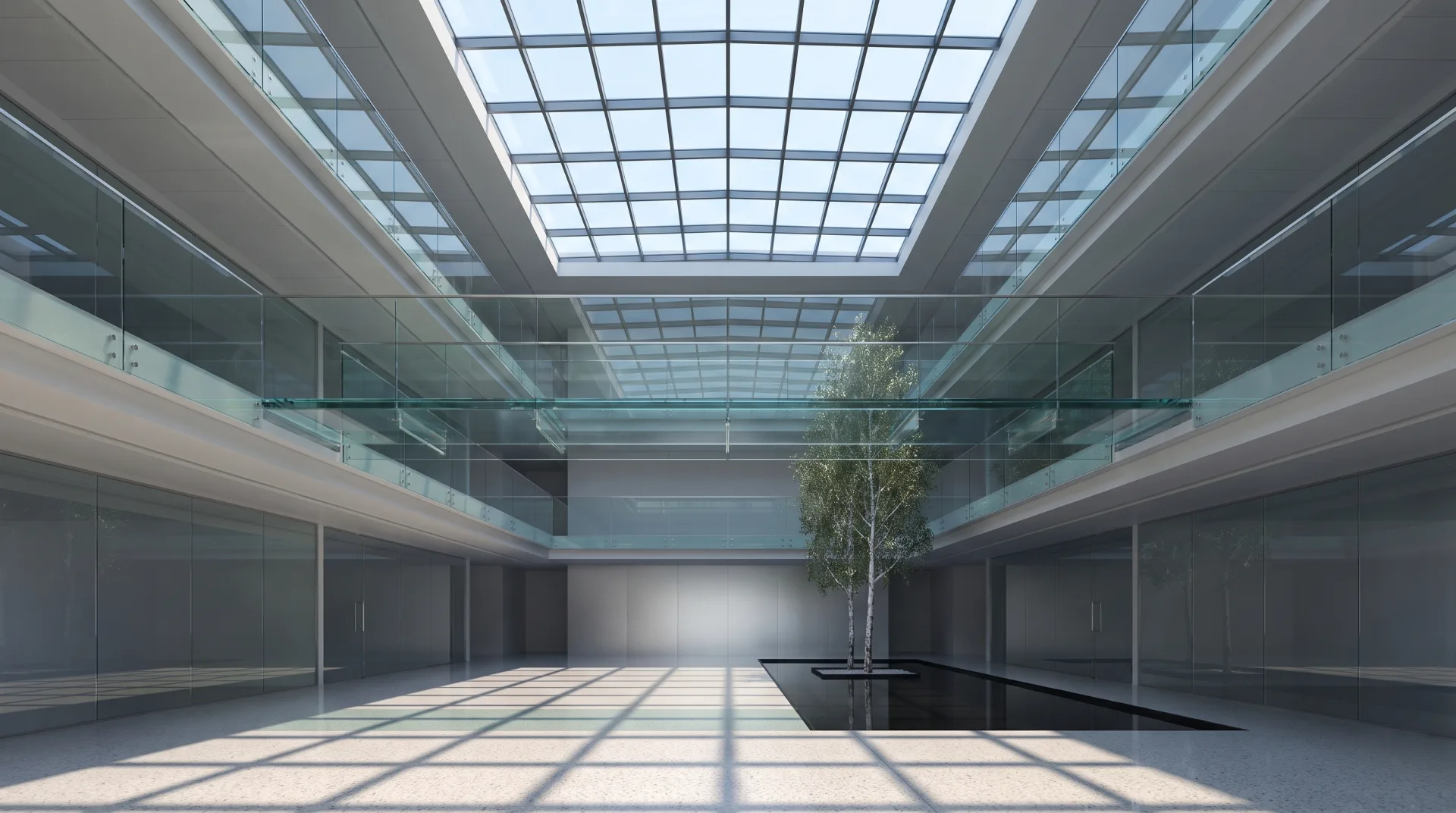
Ray tracing is one of the two main ways computer rendering turns a scene into pixels; the other is rasterization. Most answers to what is ray tracing come from gaming sites; this page explains the technique on an architectural scene instead: what ray tracing does, how it works step by step, which effects it gets right, how it runs in real time, and how it shapes the stills we deliver.
What does ray tracing do?
Ray tracing makes reflections, see-through glass and shadows behave as they would in a photograph, by calculating where light actually travels in the scene. That is the plain ray tracing meaning: instead of painting a reflection on as a texture or guessing a shadow's shape, the renderer follows lines of light through the geometry and asks what each one hits. A window then shows the street outside because a ray really bounced off the glass and found the street.
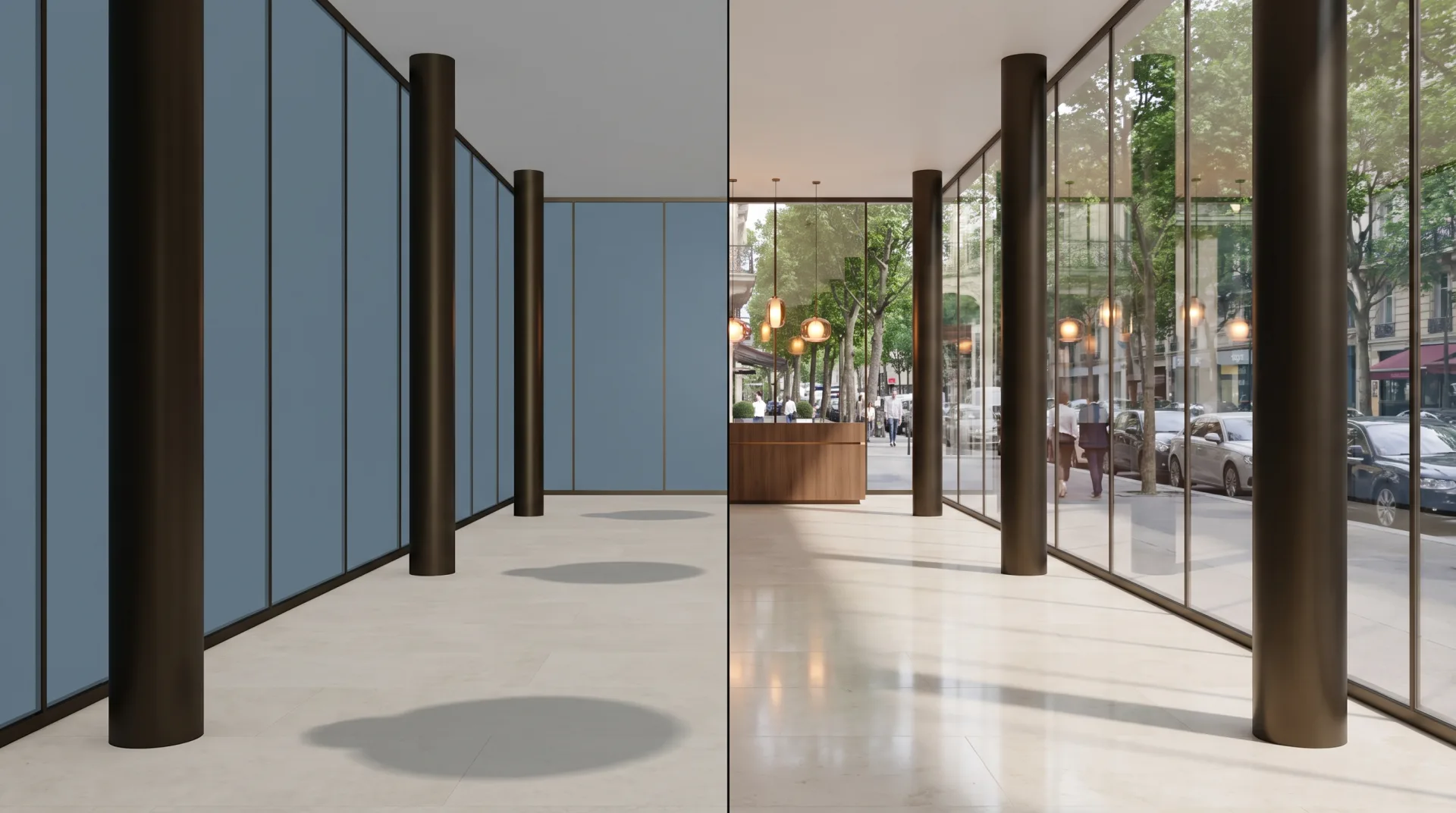
The comparison above is one hotel lobby from one camera. On the left, without traced light, the curtain wall is a flat tinted panel and the stone floor is matte. On the right, the glass carries the street and the floor mirrors the columns. Nothing in the model changed; only the way light was calculated did.
The technique is older than most people think. According to the Wikipedia article on ray tracing, Turner Whitted at Bell Labs introduced recursive ray tracing, with mirror reflection and refraction through transparent objects, in 1979. What changed since is speed, not the idea.
How does ray tracing work?
Ray tracing works by sending a ray from the camera through each pixel, finding the first surface it hits, and then tracing further rays toward lights and along reflections to decide that pixel's color. In five steps:
- Fire a primary ray. The renderer sends one ray from the camera through the center of a pixel, and in practice several rays per pixel at slightly different positions.
- Find the nearest hit. It tests the ray against the scene's geometry, using a spatial index of the triangles so it does not have to check every one, and keeps the closest surface the ray meets.
- Cast shadow rays. From that point it fires a ray toward each light; if something blocks the ray, the point is in shadow from that light.
- Spawn reflection and refraction rays. If the material is glossy or transparent, it sends a new ray in the mirrored direction, a bent ray through the glass, or both, and repeats steps 2 to 4 for each.
- Combine the results. It adds up the light returned by every ray, weighted by the material, and writes the final color to the pixel.
The loop above draws one of those paths over the lobby: a ray leaves the camera, strikes the glass, splits into a reflected ray toward the street and a refracted ray into the room, and a shadow ray from the floor checks whether the sun is visible. A 4K still has about 8.3 million pixels, and each one repeats this many times, which is why traced images take minutes rather than milliseconds.
Which effects does ray tracing get right?
Ray tracing gets reflections, refraction, shadow softness and ambient occlusion physically right, and with many bounces it also produces global illumination. Each effect below is something older shortcuts could only approximate.
| Effect | What ray tracing calculates | Where you see it in an architectural render |
|---|---|---|
| Reflections | The exact direction light leaves a glossy surface and what it meets next | Glass curtain walls reflecting the street, polished stone and wet paving mirroring lights |
| Refraction | How light bends as it passes into and out of glass or water | Water in a pool distorting the tiles, thick glass balustrades, a glass of water on a table |
| Shadows | Whether each point can see each light, so shadows are sharp near the object and soften with distance. More on how shadows are rendered, from shadow maps to traced soft shadows. | A pergola casting crisp shadows close up and blurred ones further out, the soft edge under a sofa |
| Ambient occlusion | How much of the surrounding sky or room each point can see; the contact darkening in corners is ambient occlusion | The thin dark line where a wall meets the floor, under cabinets, between roof tiles |
| Global illumination | Light that bounces off one surface and lights another. Bounced light, built up over each light bounce, is what fills a room with soft daylight | Sun on an oak floor warming the ceiling, a courtyard lit by light reflected off its walls |
Is ray tracing better than higher FPS?
Ray tracing gives more accurate light at the cost of speed: in games it lowers frames per second, while in architectural stills it adds minutes per image and no frame rate is involved. For a player, the trade is personal: some prefer smoother motion, others prefer correct reflections. For a still image that will sell an apartment or go in front of a planning board, there is no trade at all. The image is rendered once, offline, and it can take as long as accurate light needs. The cost shows up in render time and computer hardware, not in how the picture feels to the person looking at it.
What is real-time ray tracing?
Real-time ray tracing uses dedicated hardware on recent graphics cards to trace reflections and shadows fast enough for interactive frame rates, usually combined with rasterization and denoising. Ray tracing in real time arrived for consumers in September 2018, when NVIDIA launched its GeForce RTX cards with dedicated RT cores, according to Wikipedia.
Real-time engines do not trace everything. They draw the scene first with polygon rasterization, which converts triangles straight to pixels, and layer traced reflections, shadows or some bounced light on top. They also trace only a few rays per pixel, so the raw result is grainy; denoising cleans that grain up before the frame reaches the screen. Architectural tools work the same way. Unreal Engine's Lumen, for example, is a fully dynamic global illumination and reflections system that uses hardware ray tracing when the graphics card supports it and falls back to software ray tracing otherwise, as Epic's Lumen documentation describes.
Is ray tracing only on NVIDIA?
Ray tracing is not NVIDIA-only: AMD and Intel graphics cards also have ray tracing hardware, and offline renderers can trace rays on any CPU. AMD added hardware ray tracing with its Radeon RX 6000 series in October 2020, according to Wikipedia, and Intel Arc cards have a dedicated ray tracing unit for traversal and intersection tests, as Intel's developer guide explains. Hardware choices belong on the page about the GPU and computer you need for rendering.
What is replacing ray tracing?
Nothing is replacing ray tracing; path tracing extends it to all light in a scene, and AI denoising and upscaling make it faster. Path tracing is ray tracing extended to every bounce of light: instead of following only reflections and shadows, each ray keeps bouncing in random directions until it has gathered the light from the whole room. That is how film studios and architectural renderers already work, and games are moving the same way. You can see path tracing vs ray tracing compared side by side on one interior.
The other change is AI. Denoisers trained on clean images let a renderer stop after fewer rays, and upscalers render fewer pixels and fill in the rest. Both make tracing cheaper; neither replaces it, because they still need traced light to start from.
How is ray tracing used in our architectural renders?
Every final still we deliver is ray traced, path traced in Corona or V-Ray inside 3ds Max, which is what makes glass, water and polished finishes read as real. Some scenes go through Blender's Cycles, which is also a ray-based production renderer. As 3DRenderingAgency, a US studio, we never ship a rasterized preview as a final image.
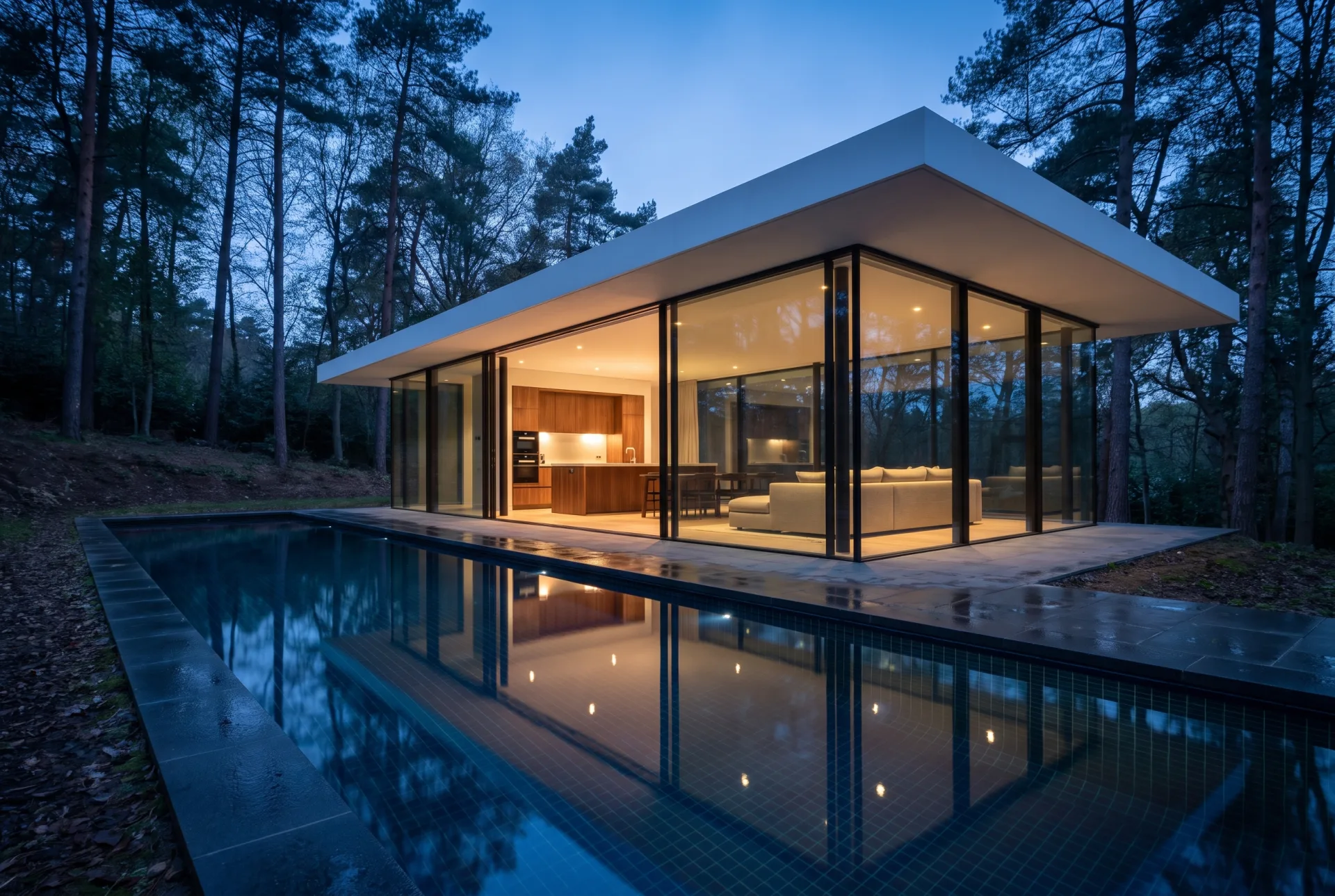
In practice, ray tracing is where a client sees the difference first. The interior lights of a glass-fronted house reflected in its pool at dusk, the street mirrored in a lobby's curtain wall, the slight bend of tiles under water: each is a traced effect, and each is checked on the draft before the final render. A typical 4K exterior still renders for minutes to a few hours depending on glass, vegetation and the number of lights. Glass facades and pools are the core of our exterior visualization, and the same engines run every view at our architectural rendering company.