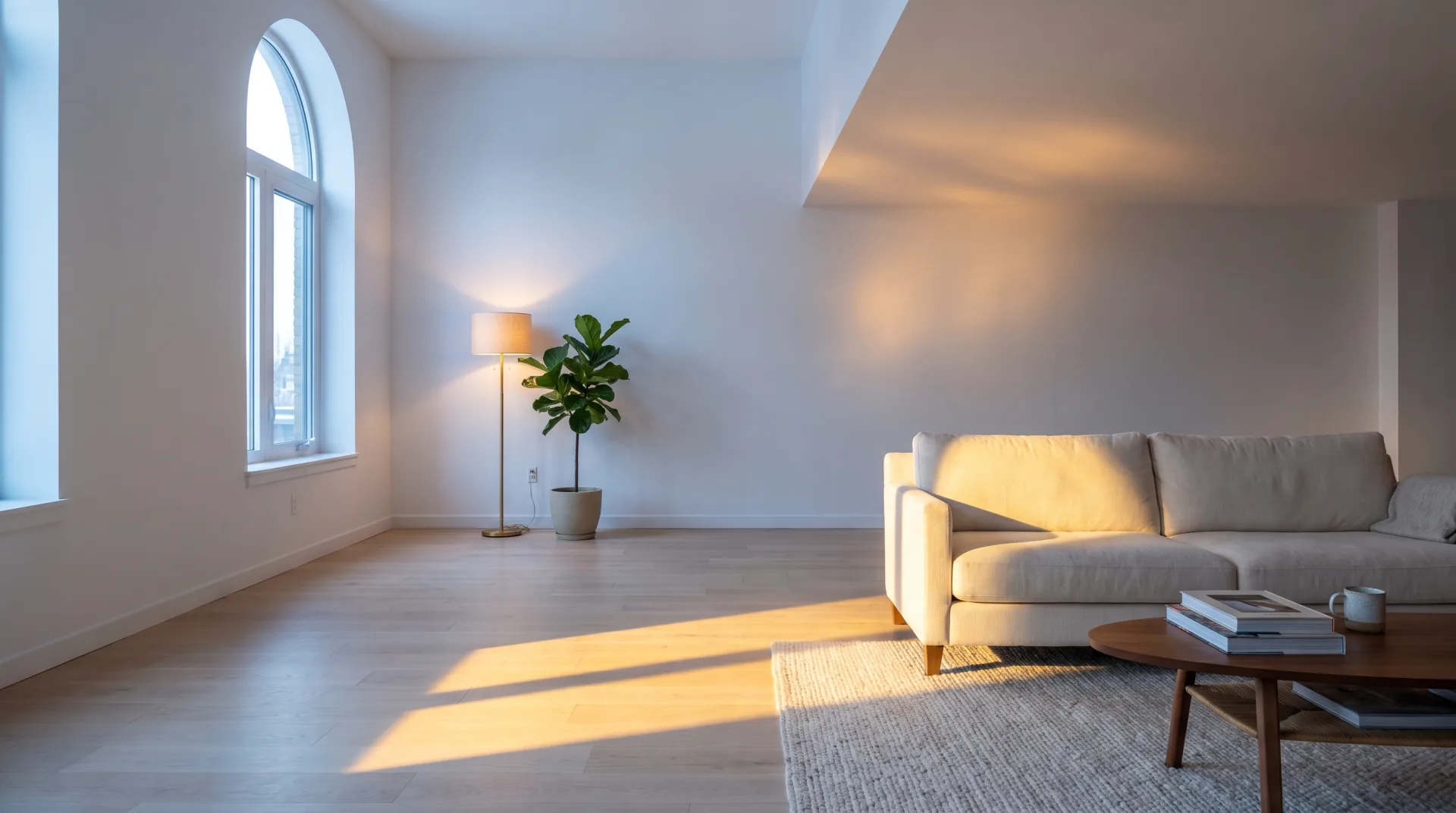
Rendering lighting is the step that turns a correct model into a believable picture, and it is the part of 3D rendering that buyers notice first, even when they cannot name it. This page covers the types of light, how lighting changes an image, direct and indirect light, how interiors and exteriors are lit differently, the six lighting concepts worth knowing before you brief a render, and the lighting options we offer.
What are the types of 3D lighting?
The main types of 3D lighting are sun (directional) light, sky or HDRI light, area lights, point and spot lights, IES lights for real fixtures, and emissive materials. Most architectural scenes use three or four of them together: a sun and sky outside, area lights or windows as soft sources, and fixture lights inside.
| Light type | What it imitates | Shadow quality | Typical use in architecture |
|---|---|---|---|
| Sun (directional) | Direct sunlight, with parallel rays from one direction | Hard, sharp-edged | Exterior day views; sun patches through windows |
| Sky or HDRI | The whole sky dome, often a photographed one | Soft, from every direction | Exterior ambient light and reflections; daylight in interiors |
| Area light | A softbox, a window opening or a lit ceiling panel | Soft; larger lights give softer shadows | Filling interiors through windows; product studio setups |
| Point and spot lights | A bare bulb, a downlight or a spotlight | Hard to medium; spots have a defined cone | Recessed downlights, track lights, accent lighting |
| IES light | A specific real fixture, using the manufacturer's photometric file. See IES lights. | Matches the fixture's real beam pattern | Wall washers, sconces and downlights that must match the lighting plan |
| Emissive material | A surface that glows, such as an LED strip or a lit sign | Soft; weak as a main light | LED strips, under-cabinet lights, signage, screens |
How does lighting change a render?
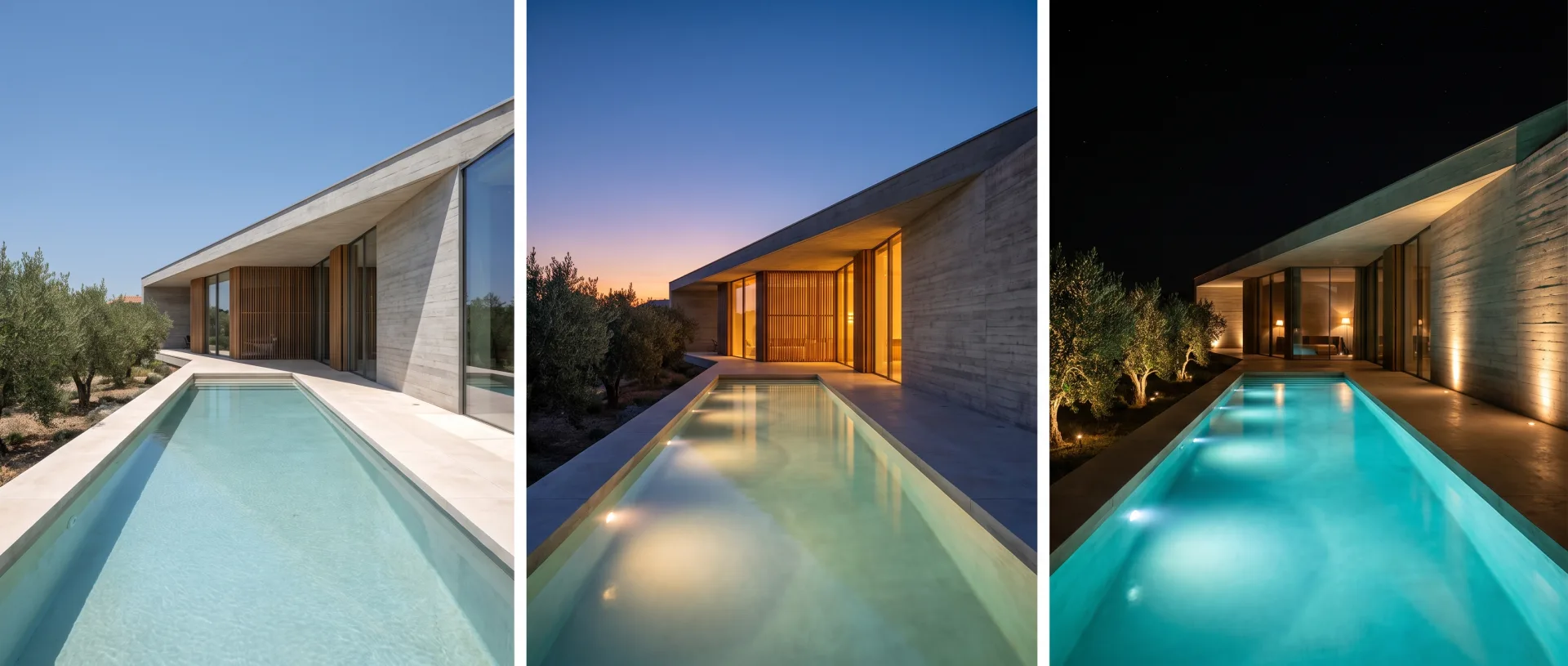
Lighting changes a render's realism through shadow direction and softness, and its mood through color temperature and contrast, which is why one model can sell very different stories. A lighting render of the same villa at noon says bright, open and practical; at dusk, with warm windows against a blue sky, it says home; at night, with uplit walls and a glowing pool, it says luxury. Much of that mood comes from color temperature: daylight reads cool and neutral, while lamps and dusk skies read warm.
Realism comes from consistency more than from any one setting. If the sun in the sky sits to the left, every shadow must fall to the right; if a room is lit by a north window, the light must be soft. Viewers rarely spot the error itself, but they feel that something is off.
What is direct and indirect lighting?
Direct lighting is light that travels straight from a source to a surface, and indirect lighting is light that has bounced off at least one surface first, calculated by global illumination. In a room lit by one window, the sun patch on the floor is direct light; the soft glow on the ceiling and the far wall is indirect light reflected from that floor. Global illumination is the part of the renderer that follows those bounces. Without it, every surface that the sun does not reach would be black, and interiors in particular would look like stage sets. Indirect light also picks up color as it bounces, so a red rug tints the underside of a white sofa slightly pink, which is one of the details that make a render look real.
How are interiors lit compared with exteriors?
Interiors are lit mainly by daylight through windows plus fixtures that match the lighting plan, while exteriors are lit by a sun and sky (often an HDRI) and, at dusk, by interior glow and landscape lights. An interior's light arrives through small openings, so most of it is indirect and the render needs many bounces to come out clean. An exterior sits in open light, so the sky does most of the work. Outside, we usually light with an HDRI, a photographed sky that supplies sun, sky color and reflections in one file.
The handover between daylight and lamps is where interiors are won or lost. In a daytime view the fixtures are off or barely visible; in an evening view the windows go dark blue and the pendants, under-cabinet strips and lamps carry the room. A render that switches every light on in full daylight looks staged, because no one lives like that.
Which lighting concepts should a buyer know?
A buyer briefing a render should know six lighting concepts: global illumination, ambient occlusion, HDRI, IES lights, shadows and volumetric light, each covered in its own guide. None needs to be specified in a brief, but knowing the words makes it easier to say what is wrong with a draft.
| Concept | One-line answer | Guide |
|---|---|---|
| Global illumination | Light bouncing between surfaces, which fills shadows and carries color | Global illumination |
| Ambient occlusion | Small contact shadows where objects meet, which ground furniture on the floor | Ambient occlusion |
| HDRI | A 360-degree photographed sky that lights and reflects the scene | HDRI |
| IES lights | Lights that follow a real fixture's measured beam pattern | IES lights |
| Shadows | Direction, length and softness of shadows, set by the size and position of the light | How shadows are rendered |
| Volumetric light | Visible beams and haze, such as sun shafts through a window or fog around streetlights | Volumetric lighting |
Which lighting does the agency offer?
We offer day, dusk and night lighting for exteriors and natural or evening lighting for interiors, chosen to fit the marketing message. At 3DRenderingAgency, a US studio where the people lighting each view have designed buildings themselves, the time of day is simply a choice in the brief, so you pick the light that tells your story: true material colors for a planning board, lit windows for a sales brochure, uplit facades for a landmark.
| Option | Mood | Best for |
|---|---|---|
| Exterior day | Bright, honest, practical | Planning images, materials sign-off, family homes |
| Exterior dusk | Warm and welcoming, lit windows against a blue sky | Sales brochures, listing covers, hero images |
| Exterior night | Dramatic, with uplit facades and landscape lights. See our night renderings. | Hospitality, retail, landmark buildings |
| Interior natural light | Fresh and airy, daylight through the windows | Living spaces, kitchens, offices |
| Interior evening | Intimate, lamps and fixtures carrying the room | Bedrooms, restaurants, hotel suites, lounges |
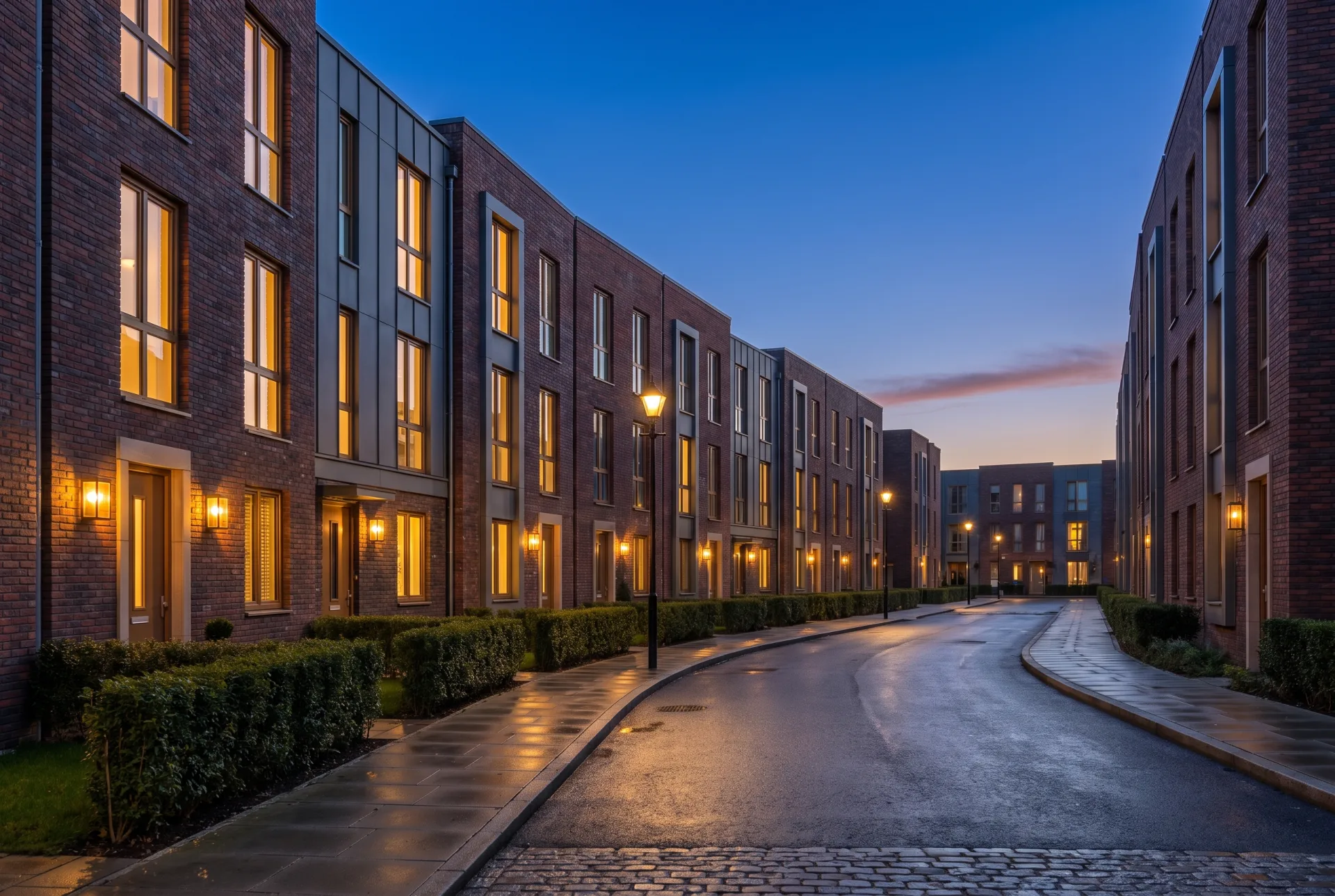
Dusk is the option most used on sales material, because lit windows tell a buyer the building is lived in. Day views remain the better choice when the image has to show true material colors, such as for a planning board or a finish sign-off. If you want both, order two views from the same camera, so one image wins the approval meeting and the other sells the homes. Buyers choose between day, dusk and night as part of our 3D exterior rendering services, where the full process and turnaround are listed.