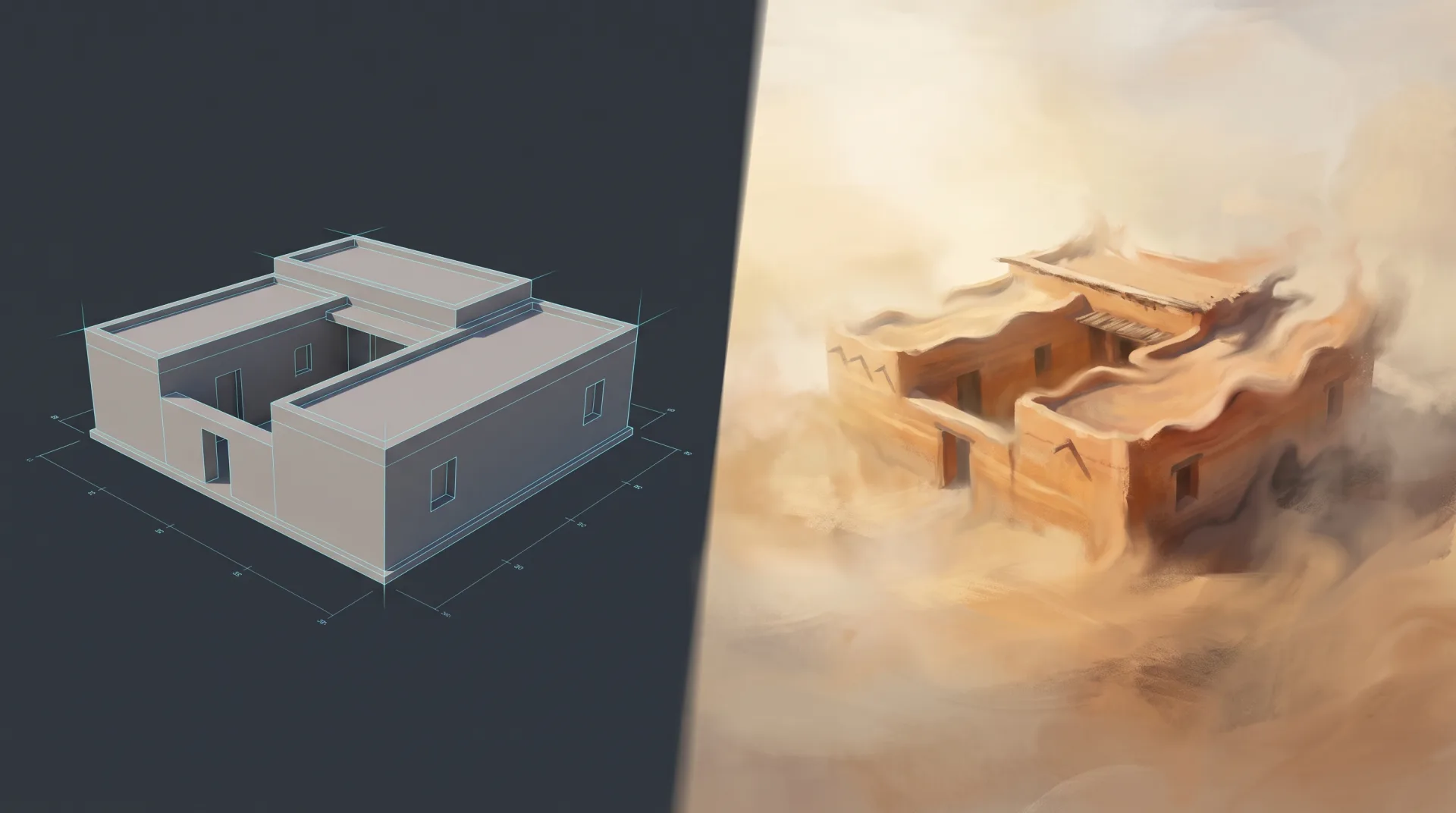
If you need the basic definition first, start with our answer to what is CGI. This page compares the two methods on the same brief, gives five checks for telling them apart, and sets out which jobs suit each. We make CGI for architects, developers and brands and use AI to brainstorm ideas and early sketches.
Is CGI AI?
CGI is not AI: CGI is rendered from a 3D model that a person built, while AI imagery is predicted pixel by pixel by a trained model, although modern CGI pipelines use AI tools such as denoisers. Is CGI the same as AI? No, because in CGI every object exists as measured geometry with assigned materials, and the renderer calculates how light falls on it. A generative model has no geometry to consult; it produces the pixels it judges most likely to fit the prompt.
The overlap is real but narrow. The clearest case of AI inside a CGI render is AI denoising: the renderer stops early and a trained network removes the remaining grain, which saves render time without changing any geometry. The model still decides what is in the picture; the AI only cleans it.
What is the difference between CGI and AI images?
CGI and AI differ in how the image is made, how much control the artist has, whether the image can be revised precisely, and whether it is measurably accurate. The 3D model is what makes CGI accurate: the building is built once at real dimensions through one of the 3D modeling techniques, and every image is a view of that one model.
| Factor | CGI (3D rendered) | AI (generated) |
|---|---|---|
| How made | An artist models the object, adds materials and lights, and renders it | A trained model predicts an image from a prompt or reference image |
| Control | Every dimension, material and light is set by hand | Guided by the prompt and input image; details are chosen by the model |
| Accuracy to drawings | Matches the drawings, because the model is built from them | Approximate; window counts, heights and finishes drift |
| Same object from new angle | Identical, because it is the same model | A new image that may disagree with the first |
| Revisions | Precise: change one tile and only the tile changes | Regenerate and hope, or patch by hand |
| Typical turnaround | Days: our first draft is 3 to 5 business days | Seconds to minutes per image |
| Typical use | Approvals, sales, catalogs, animation, tours | Early mood images, options, social teasers |
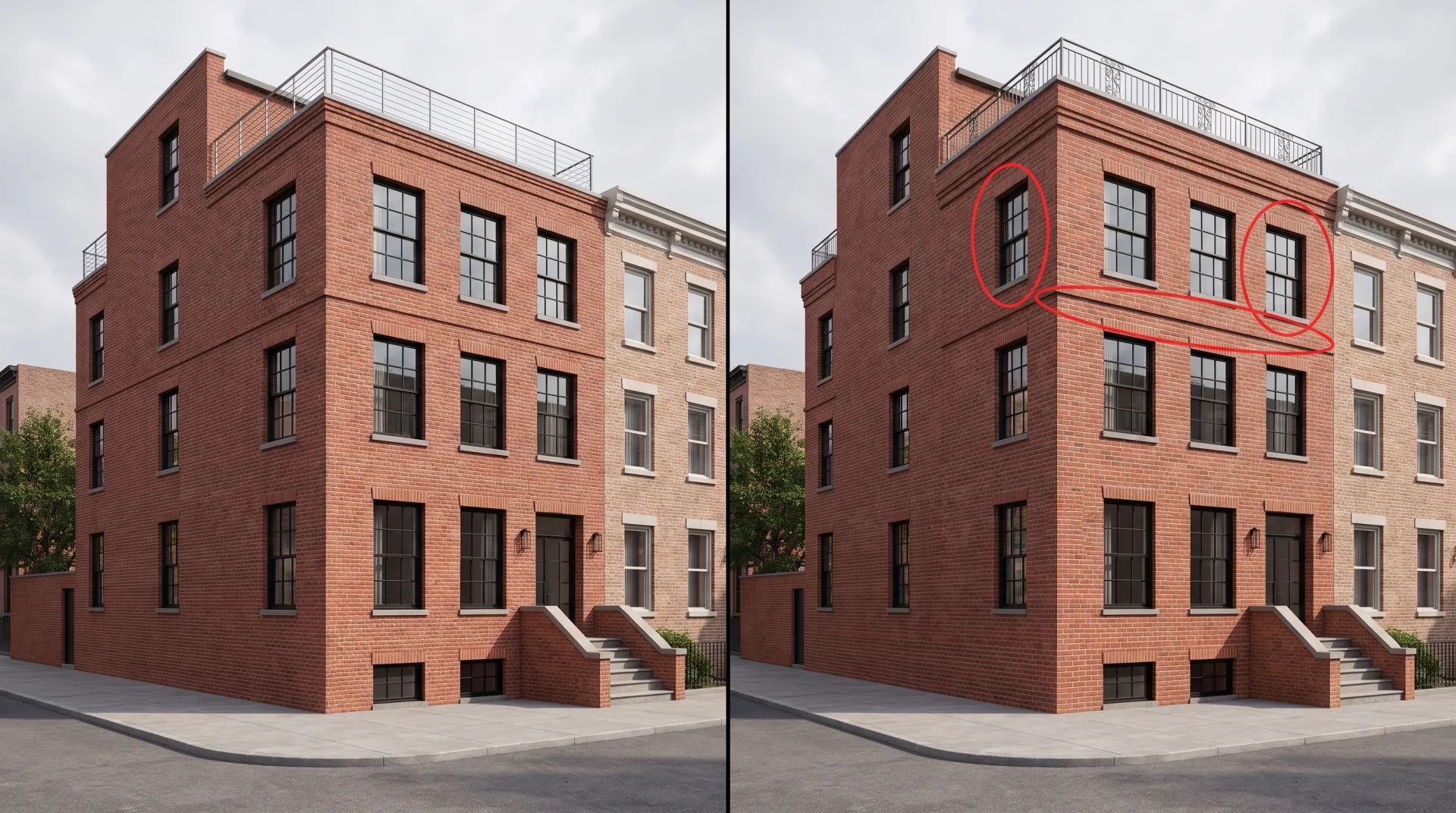
The image above takes one brief, a three-story brick townhouse with black steel windows, and makes it both ways. The CGI version follows the drawings. The AI version, labeled as an AI-generated example, is attractive and wrong in ways a buyer would notice once the building stood: an extra window bay, floor heights that do not line up with the neighbors, brick coursing that changes size.
What's better, CGI or AI?
CGI is better when the image must match drawings, a product's real dimensions or a planning submission, and AI is better for fast early mood images where accuracy does not matter yet. The decision rule is simple: if anyone will compare the image with the real thing, use CGI.
| Task | Better choice | Why |
|---|---|---|
| Planning submission | CGI | Reviewers compare the image with the drawings |
| Pre-sales brochure | CGI | Buyers rely on the image; it must match what is delivered |
| Product listing on Amazon | CGI | The product shown must be the product shipped, in every color |
| Early massing mood | AI | Speed and variety matter; nothing is fixed yet |
| Social media teaser | AI or CGI | AI for a loose mood post; CGI once the design is final |
| Configurator | CGI | Every option must be modeled to combine correctly |
How to tell CGI from AI?
CGI can be told from AI by consistency: in CGI every window, railing and joint repeats exactly and stays the same from every camera angle, while AI images change details between views and blur text, hands and repeated elements. Real CGI is built, so it is regular where the building is regular. Five checks catch most AI images.
- Check repeated elements. Count the windows, balusters or tiles along one row; in CGI they are identical and evenly spaced, in AI they vary in size and spacing.
- Compare two views. Look at the same corner in two images of the set; CGI agrees between views, AI often adds, moves or removes a window, a step or a light.
- Read the text and signage. CGI shows legible signs because they were placed as images; AI tends to produce near-letters that do not spell words.
- Follow the shadows. In CGI every shadow falls from one sun in one direction; AI images often mix shadow directions or lengths.
- Look at hands and faces. People added to CGI are photographed or modeled; AI people often have wrong fingers, merged limbs or warped faces in the background.
Can people tell a CGI render from a real photo?
A well-made photoreal CGI render is usually indistinguishable from a photograph for most viewers, which is why developers sell homes from renders before construction. The CGI vs real test is passed by lighting and imperfection: correct sun angle, slight wear on surfaces, real lens behavior. A render fails it when every surface is perfect and every edge is razor-sharp.
Is CGI being replaced by AI?
CGI is not being replaced by AI for work that must be accurate; studios are adding AI to speed up drafts, textures, denoising and backgrounds while keeping the 3D model as the source of truth. AI render tools now sit beside the CGI pipeline, turning sketches and model screenshots into concept images in seconds. What they cannot do is guarantee that the tenth image of a project agrees with the first, and a sales campaign or a planning set is many images that must agree.
Do movies use AI or CGI?
Movies use CGI for their visual effects and are adding AI tools for tasks such as de-aging, rotoscoping and upscaling inside the CGI pipeline. Film CGI has a history of more than 50 years, back to Westworld in 1973, traced in our history of CGI. The AI tools arrived inside that pipeline. The film Here (2024) used a generative AI system, Metaphysic Live, to de-age its actors in real time during filming. Industrial Light and Magic's work de-aging Harrison Ford for Indiana Jones and the Dial of Destiny combined its face-swap tools with CG assets. In July 2026 Foundry released an AI rotoscoping add-on for Nuke that moves roto shapes to follow a subject across a shot. In every case the AI serves a CGI and compositing workflow rather than replacing it.
Where does the agency use AI, and where does it use a 3D model?
We use AI to brainstorm ideas and early sketches. Every final image is built from a 3D model, so the views, dimensions and materials can be checked and revised. The rule we work to as a 3D visualization company is that AI may suggest ideas, but the model decides what is in the picture.
| Stage | Tool used | Why |
|---|---|---|
| Ideas and early sketches | AI image tools, to brainstorm options | Fast variety before anything is fixed |
| Model | 3ds Max, Blender, or the client's Revit, SketchUp or Rhino file | The single source of truth for dimensions and materials |
| Materials and lighting | Corona, V-Ray or Cycles | Physically based light that behaves the same in every view |
| Render | Corona, V-Ray or Cycles, with the renderer's denoiser | Accurate images; the denoiser saves time without changing geometry |
| Post-production | Photoshop, for color, contrast and finishing | Final polish on top of a correct render |
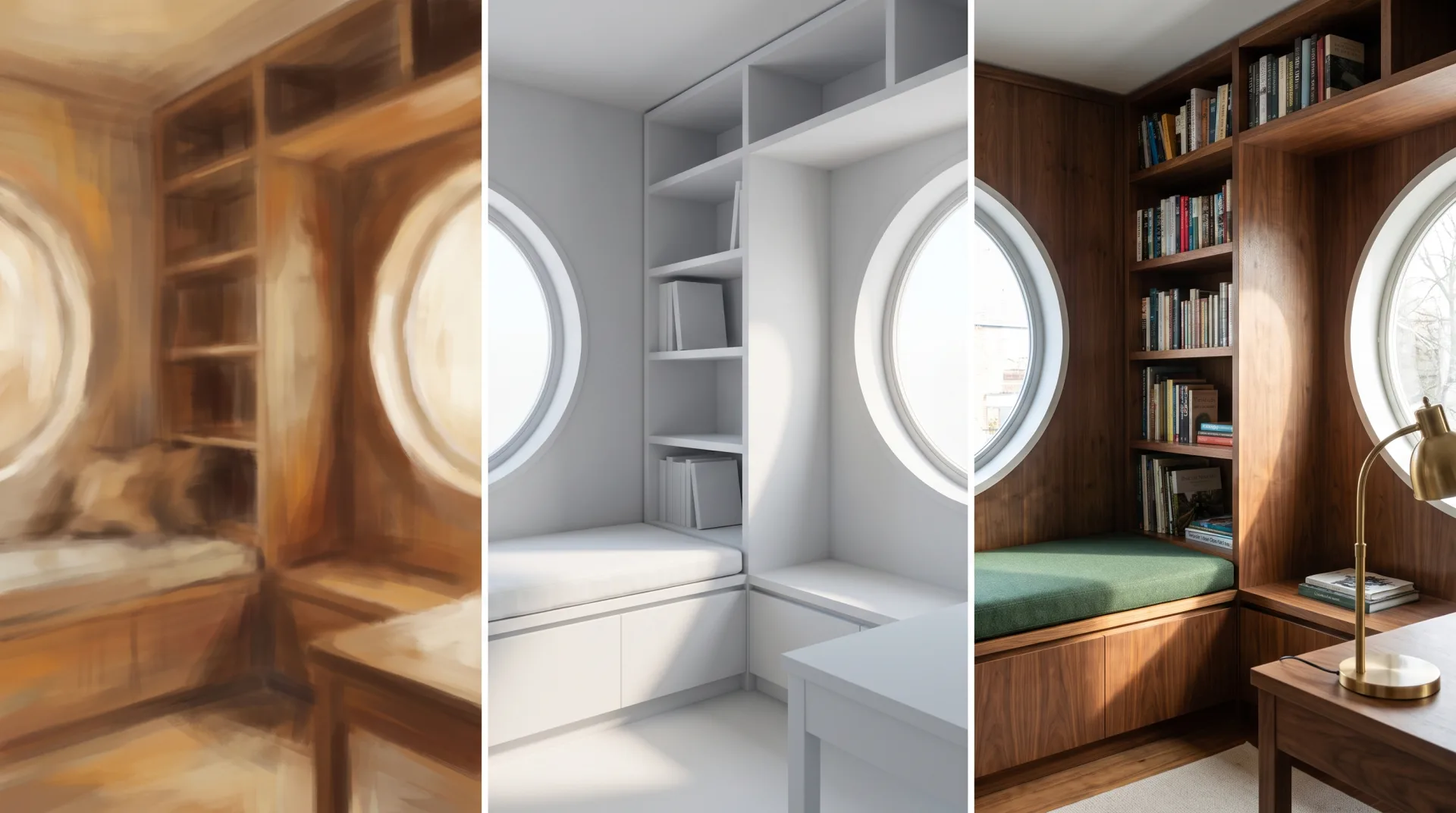
Because the final image is a view of a model, revisions are exact: two rounds are included, and each change lands where it was asked for without disturbing the rest of the image. Buildable, checkable visuals come from our 3D architectural visualization service, where people trained in architecture and interior design build the model from your drawings, with AI used only to brainstorm ideas and early sketches.