This page is part of our guides to buying 3D rendering. It is written for the person paying for the work: an architect, a developer, a designer or a product brand deciding who to hire.
Freelancer vs agency at a glance
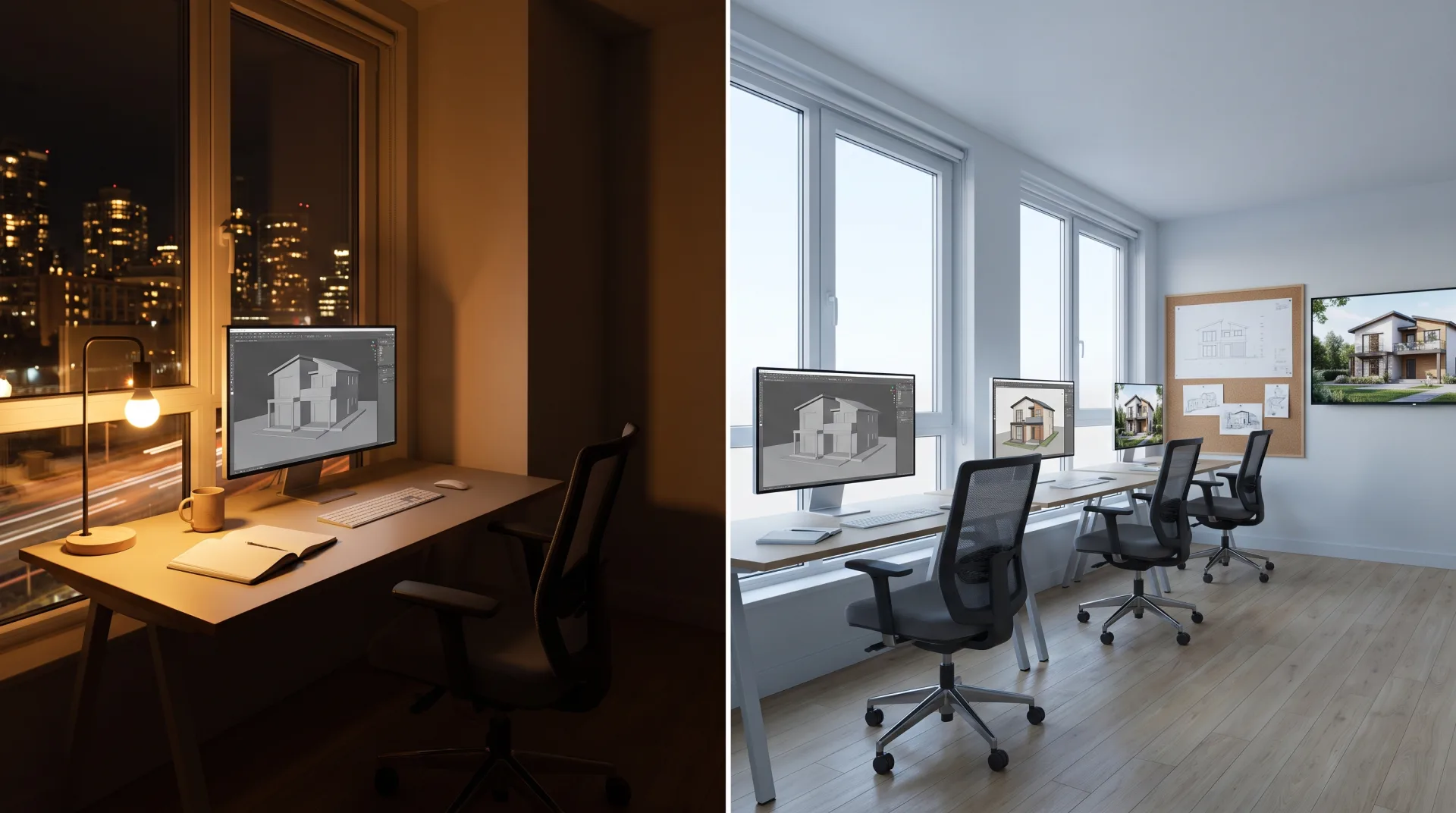
The table compares a freelancer and an agency on what the fee covers, capacity, quality checking, deadline cover, communication and continuity. Neither column is better on every row; the right choice depends on which rows matter for your project.
| Criterion | Freelancer | Agency |
|---|---|---|
| What the fee covers | The artist's own hours, often billed by the hour or day | A fixed quote per view or model, with project management and checking included |
| Capacity | One person's hours: several views run one after another | Several artists: views run side by side |
| Quality checking | The artist checks their own work; the rest falls to you | A second person reviews against the drawings before you see a draft |
| Deadline cover | Illness, holidays or another client move your date | Work is reassigned inside the team; the date is the agency's to keep |
| Communication | Direct with the person doing the work | Through a project contact who briefs the artists |
| Continuity | Depends on one person staying available | The files and the method stay with the agency for the next project |
Our 3D rendering pricing is published for comparison, so you can set it against any freelance quote line by line.
What do you get when an agency builds your 3D model?
When an agency builds your 3D model, you get a model made to your drawings and checked against them, a fixed quote before work starts and a delivery date the agency is answerable for. With us, the people building it have trained in architecture and interior design, so they read plans, sections and finish schedules correctly the first time and your review rounds go on refinements rather than corrections.
| What you get | Why it matters to you |
|---|---|
| A fixed quote within 12 hours of us receiving the files | You know the scope and the cost before you commit, with no hours to estimate |
| Modeling to your drawings by our own team | Dimensions, details and materials match your drawings, so fewer corrections |
| Two revision rounds included | Changes are planned into the schedule from the start |
| First draft of stills in 3 to 5 business days | A date you can plan a presentation or a launch around |
| 4K JPG and PNG files with full commercial rights | Images you can use in print, on the web and in listings without a time or place limit |
| Native files accepted from Revit, SketchUp, Rhino, 3ds Max, AutoCAD and Archicad | You send the model you already have |
An hourly quote becomes a firm figure only once you know the hours, and a model that needs a second pass takes the hours twice. Our 2D to 3D modeling service builds the model from your drawings under a fixed quote, so a model that is right the first time is the agency's problem to deliver, not yours to check line by line.

When a freelance 3D artist is the right choice
A freelance 3D artist suits one-off models, flexible deadlines and buyers who can judge accuracy themselves. In those cases the agency's extra layers (a project contact, a second checker, spare capacity) are cost you do not need.
- You need one model or one image. A single, clearly defined asset does not need a team behind it.
- Your deadline can move. If a week's slip costs you nothing, you do not need to pay for deadline cover.
- You can check the work yourself. An architect who can spot a wrong sill height, or a product designer who knows the part, is the second pair of eyes an agency would otherwise provide.
- You have found an artist whose portfolio matches your project closely. A specialist in your exact field, such as jewelry or furniture, can be better at it than a generalist team.
- You want to work directly with the person modeling. Some buyers prefer to talk to the artist rather than through a project contact.
When an agency is the right choice
An agency is worth it when several views must match, a deadline is fixed, the files are complex, or nobody on your side has time to check the work. Each of those turns the freelancer's lower price into risk you carry yourself.
- Several views must match. Five interiors of one apartment need the same materials, light and camera height; one team working from one model keeps them consistent.
- The deadline is fixed. A planning hearing, a launch or a sales event does not move if an artist falls ill.
- The files are complex. A Revit model with linked files, or a full set of construction drawings, needs someone who reads them as an architect would.
- Nobody on your side has time to check. If drafts go unchecked until the client sees them, errors reach the client.
- You order often. Architecture firms outsourcing architectural rendering on every project usually move to an agency for capacity and for one method across jobs.
If several of those apply, a 3D rendering agency like ours, with every file read against the drawings, two revision rounds included and a first draft of stills in 3 to 5 business days, is the safer buy.
Where to hire a 3D modeler
You can find a 3D modeler for hire on marketplaces such as Fiverr, Upwork and Cad Crowd, through portfolio sites such as Behance and ArtStation, or directly from a studio. Each route differs in how prices are set and who checks the work.
| Where | How the price is set | Who checks the work |
|---|---|---|
| Fiverr | The artist's fixed-price packages, plus a service fee shown at checkout | You |
| Upwork | Proposals on your job post: hourly or fixed price by milestone | You |
| Cad Crowd | A design marketplace for CAD and 3D work | You, unless agreed otherwise |
| Behance or ArtStation | Portfolio sites: you contact the artist and agree a price directly | You |
| A rendering studio | A price per view or model, usually in a written quote | The studio, then you |
Fiverr and Upwork: what you get
Fiverr 3D modeling gigs are fixed-price packages and Upwork jobs are proposals from individual artists; on both, checking the work falls to you. On Fiverr, each gig offers up to three packages, Basic, Standard and Premium, each with its own price, delivery time and number of revisions, and some artists ask you to send a request before you order. On Upwork you post a job and a 3D artist for hire replies with a proposal; on a fixed-price contract you fund each milestone in advance and the platform releases it when you approve the work. Both platforms add their own fees to your bill, so check the current terms on each before you compare a gig price with a studio quote.
Is AI replacing 3D modeling?
AI can now generate rough 3D models from images or text, but models built to drawings, dimensions and specified products still need a modeler. A generated model is a shape that looks right from a distance; its dimensions, joints and topology are guesses. For a concept or a placeholder that is enough. For a building that must match its permit set, or a product that must match its CAD, it is not. Our guide to AI rendering software shows where the tools help and where they stop.
Questions to ask either one before you hire
Ask for work in your project type, the price per view or model, included revisions, the file formats delivered and a dated schedule. Put the same questions to a freelancer and an agency, and compare the answers side by side.
- Can you show three projects like mine? Ask for ordinary views, not only the best image.
- What is the price per view or per model, and what does it include? Check that modeling, resolution and usage rights are in it.
- How many revision rounds are included, and what does another cost? Get both answers in writing.
- Which file formats will you deliver? Ask for the native model if you want to reuse it, as well as the images.
- What are the dates for the draft and the final files? A dated schedule, not a number of days, is what you can hold someone to.
- Who owns the files and the copyright? Get the answer in the contract, before work starts.
The full list, with ten questions and the answers to expect, is in our guide to choosing a 3D rendering vendor.