Service
Augmented Reality Furniture and Product Models
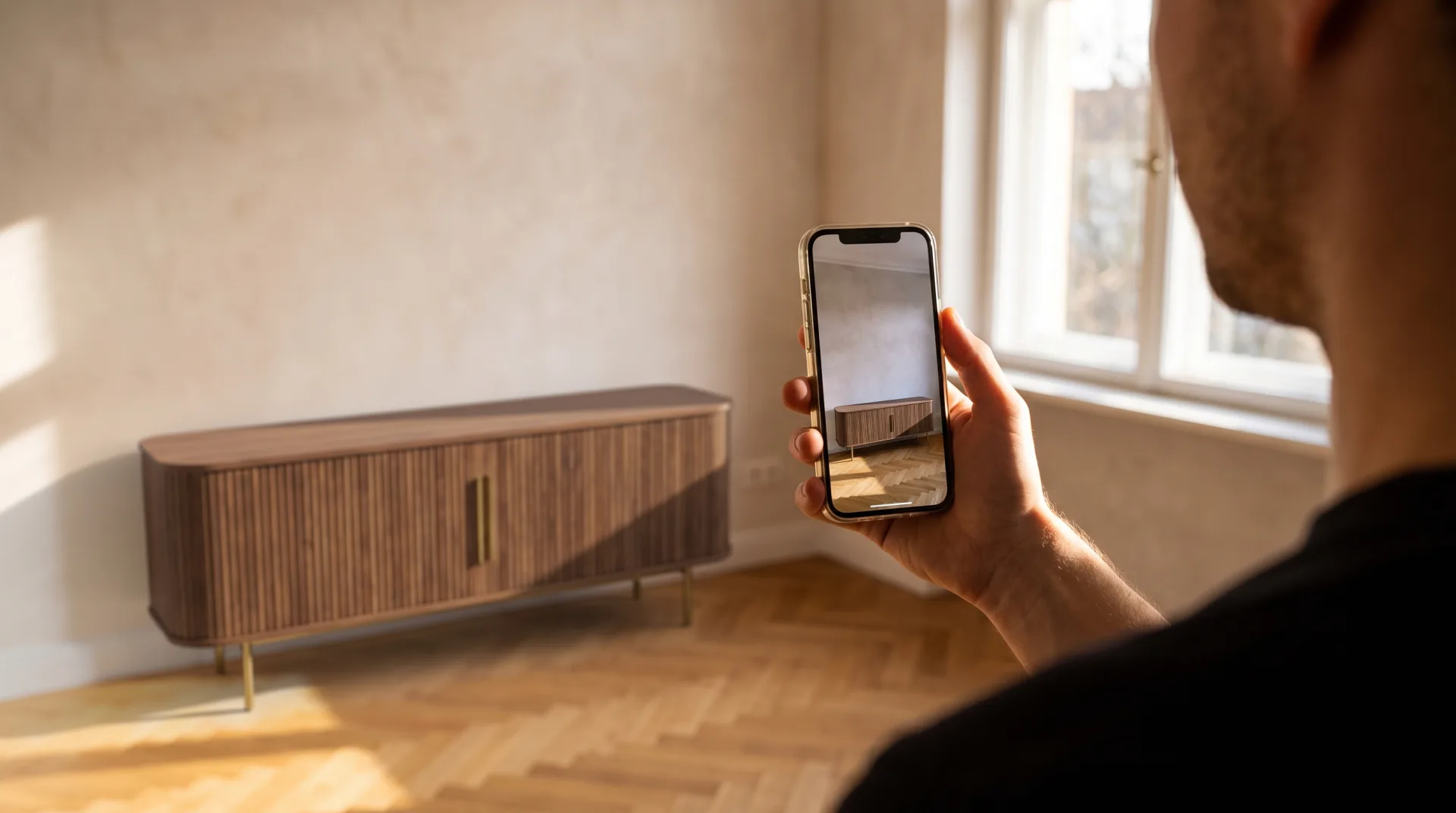
Augmented reality furniture lets a shopper see a true-to-size 3D model of a sofa, table or lamp in their own room through a phone camera, and we build those AR models as GLB and USDZ files for furniture brands and ecommerce stores, as part of our online 3D rendering service. Each model is built from your CAD files or photos so shoppers can check size and fit before they buy, loads fast in Apple's AR Quick Look, Google's Scene Viewer and Shopify product pages, and arrives on the delivery date fixed in a quote sent within 12 hours.
Includes
Modeling from CAD or photos
Files
GLB and USDZ
Modeling from CAD or photos
Includes
GLB and USDZ
Files
AR Quick Look and Scene Viewer
Checked
Two rounds included
Revisions
01
How does augmented reality furniture work?
AR furniture works by loading a true-to-size 3D model into the phone's camera view, so the product sits on the floor of the shopper's room at its real dimensions. On an iPhone or iPad, Apple's AR Quick Look opens USDZ files straight from Safari, Messages and Mail; on Android, Google's Scene Viewer does the same with GLB files from a website or app. The shopper needs no special app, only a product page that links the model.
- 01The shopper taps the AR button on the product page.
- 02The phone's camera detects the floor or tabletop.
- 03The model loads at its real scale, anchored to that surface.
- 04The shopper walks around it, moves it and rotates it to see whether it fits.
02
What do you get with our AR model service?
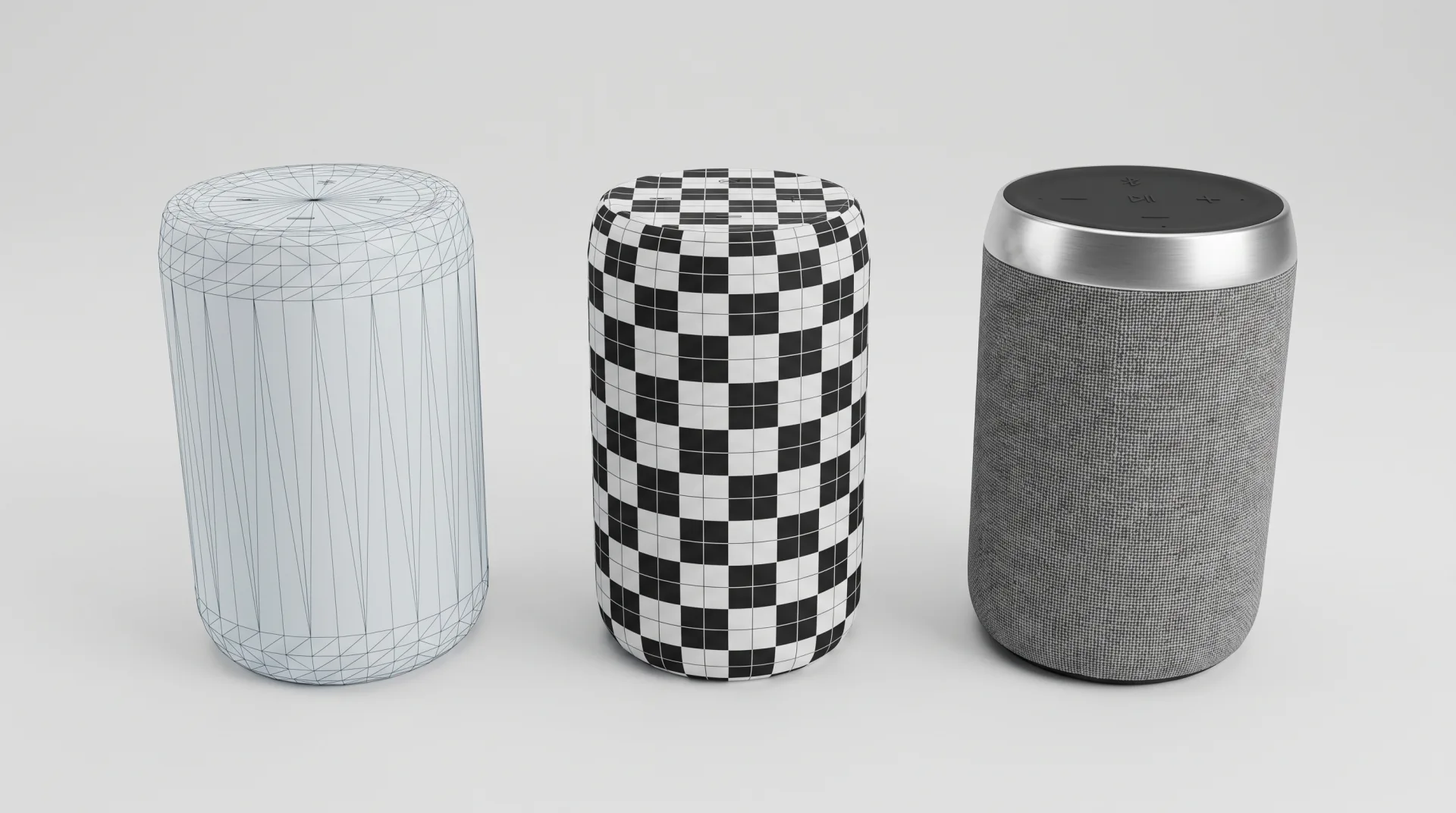
An AR model order delivers a lightweight, true-scale GLB and USDZ of each product with accurate materials, checked in Apple's AR Quick Look and Google's Scene Viewer. This is the part of 3D ecommerce a shopper actually touches, so we build to the limits the viewers publish rather than to the detail a close-up render needs. Google recommends Scene Viewer models stay under 100,000 triangles and 10 MB, with textures no larger than 2,048 by 2,048 pixels; a clean 3D mesh is how a sofa keeps its soft cushions inside that budget.
| Item | Spec | Notes |
|---|---|---|
| GLB file | glTF 2.0 binary | For Android, the web and Shopify |
| USDZ file | Apple's AR format | For iPhone and iPad AR Quick Look |
| Polygon budget | Under 100,000 triangles | Google's recommended Scene Viewer limit; most products need far fewer |
| Texture size | Up to 2,048 by 2,048 pixels | Google's maximum for Scene Viewer |
| File size | Under 10 MB | Google's recommended Scene Viewer limit, so the model opens quickly on a phone |
| Scale check | Real dimensions | Measured against your drawings or spec sheet before export |
| Viewer check | iOS and Android | Opened in AR Quick Look and Scene Viewer before delivery |
Why teams send us their drawings
Drawn by architects
Plans, sections and finish schedules are read the way they were drawn, so the first draft is close.
Priced before we start
A fixed quote within 12 hours of receiving your files. The quote you accept is the one you pay.
A clay draft first
Camera angles and massing are agreed on a plain model before materials go on, so the final has no surprises.
Yours to use anywhere
Full commercial rights and 4K JPG and PNG files for print, web and listings.
03
AR models we have built
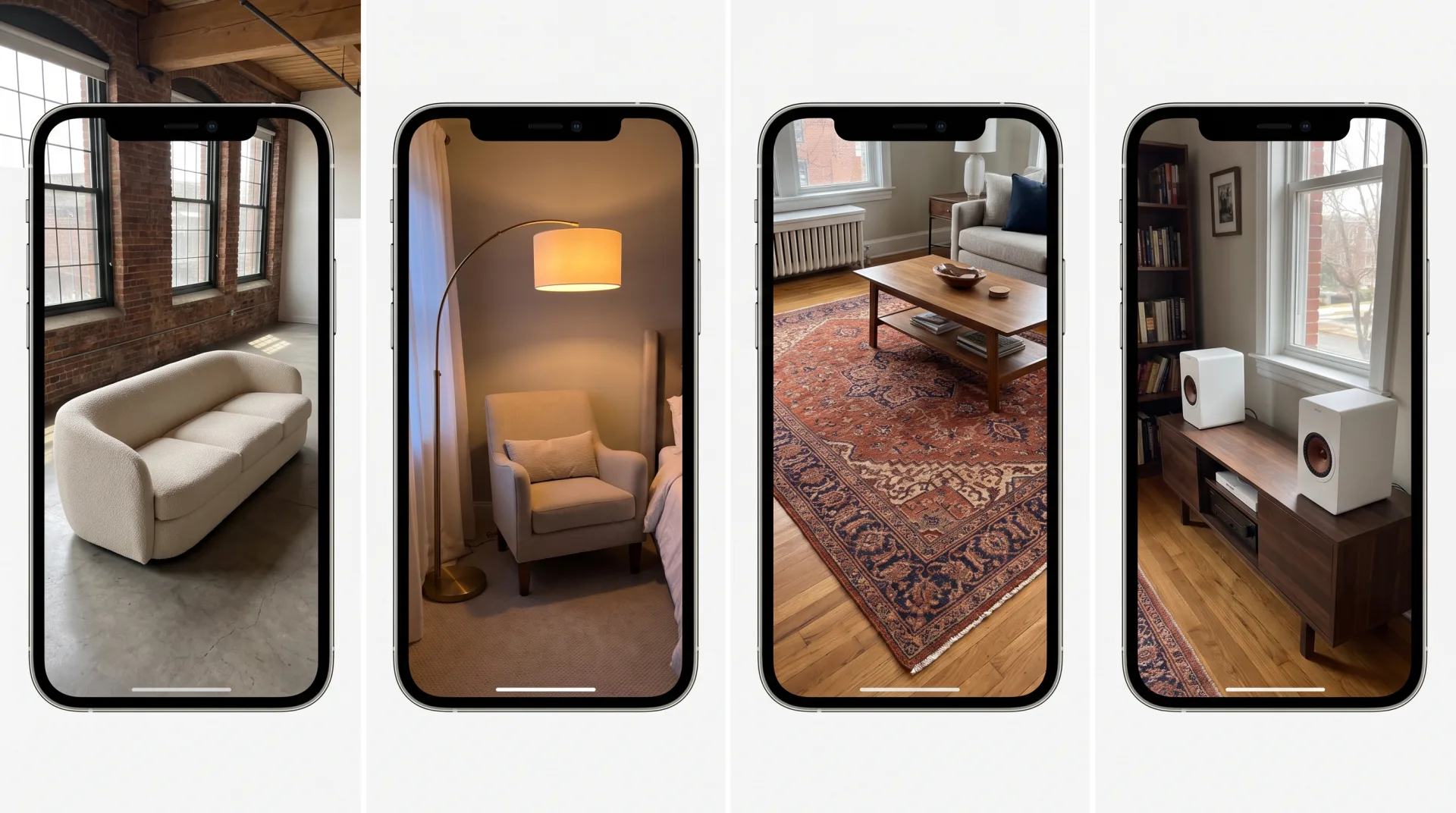
The strip below shows four AR products as phone screenshots in real rooms: a sofa, a floor lamp, a rug and a bookshelf speaker. They are concept work showing what a finished AR model looks like on a phone.
04
Who uses AR for ecommerce?
Furniture brands, home decor stores and product sellers with configurable or large items order AR models to reduce 'will it fit' returns. AR for ecommerce is most useful where size and scale decide the sale: a sofa that might block a doorway, a dining table that might crowd a room, a rug that might be too small. AR for furniture is the most established use because those are exactly the questions a photo cannot answer. The same product model also makes catalog images, which is why many brands order AR with 3D furniture rendering and model each piece once.
What clients said about our interior designer's work
I sent over our floor plans and a few reference photos, and they took it from there. What stood out was how little back-and-forth we needed. They understood the brief and got most things right on the first attempt. The final images were exactly what our marketing team needed.
Robert Hayes · United States
We were struggling to agree on finishes for a client's kitchen renovation. Having the different options rendered made the decision so much easier. It saved us from making what could have been a very expensive mistake. Money well spent.
Emily Carter · United Kingdom
Honestly, the first draft wasn't quite what I had pictured. I sent through my comments, and the revised version was spot on. I appreciated that they actually listened rather than rushing through the changes. Happy with how everything turned out.
Daniel Cooper · Australia
05
What are good augmented reality apps for furniture?
IKEA Kreativ, Wayfair's View in Room 3D and Amazon's View in Your Room let shoppers place furniture in AR, and any store can offer the same with GLB and USDZ models on its product pages. Amazon tells sellers that View in Your Room lets customers preview furniture, decor and wall-mounted items in their own space, with no cost to add 3D models to a listing. Wayfair's View in Room 3D, as Engadget reported, also places products in a photo of a room. A brand's own site does not need an app at all: the phone's built-in viewers open the files.
Does IKEA have augmented reality?
Yes: IKEA Kreativ, launched in 2022, scans a room, erases the existing furniture and lets shoppers place products from IKEA's catalog in the scan. It works on IKEA's own catalog; a brand that wants the same for its products needs its own AR models.
06
AR product visualization beyond furniture
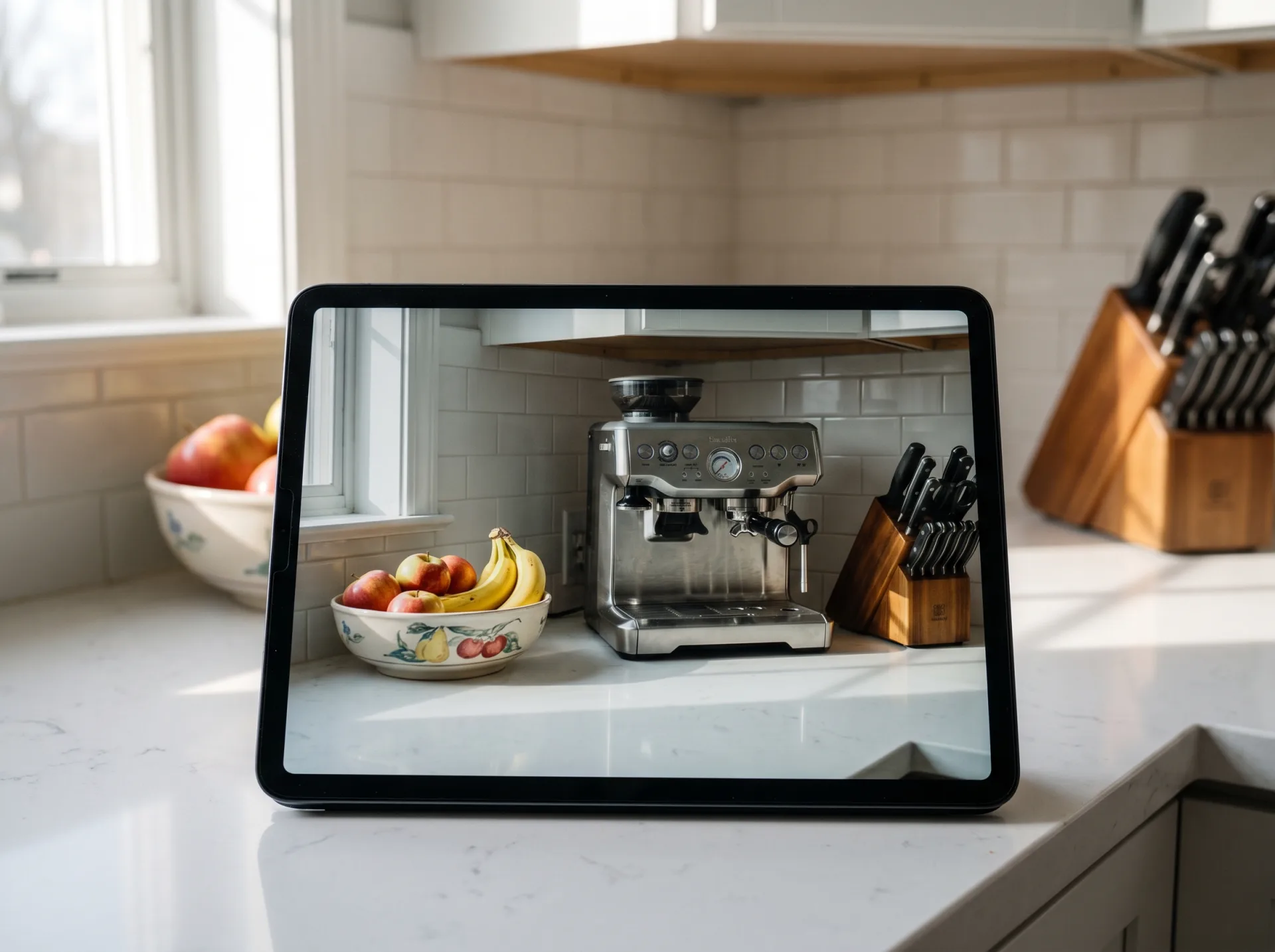
AR product visualization works for any product a shopper wants to see at size, such as lighting, appliances, decor and fitness equipment. Augmented reality product visualization answers the same question for an espresso machine on a counter as for a sofa on a floor: does it fit, and does it look right here. Where AR is not supported, or the buyer is on a laptop, 360 product views show the product from every side instead. Products with many options benefit from 3D product configurators, which let shoppers choose a fabric or finish before they view the result in AR.
07
What does an AR furniture model do for your store?
An AR model lets shoppers place your product in their own room at its real size, so they settle whether it fits before they buy rather than after it is delivered. It turns the product page into a fitting room that works on the phone the shopper already holds.
- Shoppers see scale, color and finish against their own floor, walls and furniture, the questions a photo cannot answer.
- No photo shoot is needed: we model the product from CAD files or photos, so AR can launch before samples reach a studio.
- Every color or fabric variant comes from one model, each listed in the fixed quote before work starts.
- The same files work on iPhone, Android and Shopify with no app to install, and marketplaces such as Amazon accept 3D models on listings.
- The model can be reused for catalog and lifestyle images later, so each product is modeled once.
- You own the files with full commercial rights, to use on your own store and on every marketplace that takes them.
Every service and its 3D rendering cost is on our pricing page.
08
How long does an AR model take?
The delivery date for AR models is set in the fixed quote, and it is shorter when we already hold the rendering model. AR models start from an accurate product model, so if we have built one for your images through 3D product modeling, only the optimization and export remain.
| Stage | Time |
|---|---|
| Fixed quote with delivery date | Within 12 hours of receiving your files |
| Products we have already modeled | Optimization and export only, dated in the quote |
| New products | Modeling, optimization and export, dated in the quote |
09
What do you need to send us?
Send CAD or product photos with dimensions, material swatches, and the platforms where the model will appear.
- 01Send CAD files, or photos from all sides with the overall dimensions.
- 02Add fabric, wood and metal swatches, or close-up photos of each material.
- 03List the color and fabric variants you want.
- 04Name the store platform: Shopify, WooCommerce or a custom site.
- 05Give any file size limit your platform or theme sets.
10
How do revisions work?
Revisions check scale and materials on draft GLB and USDZ files you open on your own phone, before final export, with two rounds included.
- 01Open the draft model in AR and check its size against the real product or a tape measure.
- 02Check the materials in daylight and lamplight: fabric texture, wood tone and metal finish.
- 03Send comments with screenshots from your phone.
- 04Approve the final for export in every format and variant.
11
What file formats do you deliver?
AR models are delivered as GLB for Android and the web and USDZ for Apple devices. Shopify accepts both, with 3D model files up to 500 MB, and optimizes files above 15 MB itself; we deliver far smaller files so you never rely on that.
| Format | Platform | Notes |
|---|---|---|
| GLB | Android Scene Viewer, web viewers, Shopify | One binary file holding the mesh, materials and textures |
| USDZ | iPhone and iPad AR Quick Look, Shopify | Apple's packaged AR format |
12
Is augmented reality still a thing?
AR shopping is supported natively on iPhone and Android and by Shopify, so it has become a standard product page feature rather than a novelty. Apple builds AR Quick Look into Safari, Messages and Mail; Google's Scene Viewer runs on Android devices with ARCore; Shopify takes GLB and USDZ as product media; and Amazon offers 3D and AR on listings at no cost to sellers. The novelty has gone; the use, checking size before buying, has stayed.
Questions
Do AR models work on Shopify?
Yes. Shopify accepts GLB and USDZ files as product media, and a theme that supports 3D models shows them on the product page. We deliver both formats for each product.
How big can the files be?
Shopify accepts 3D files up to 500 MB, but phones open small files far faster. We build to Google's recommendation for Scene Viewer, under 10 MB, so the model loads in seconds on a mobile connection.
Can you make AR models from photos?
Yes. Photos from every side and the overall dimensions are enough to model most products, and modeling is included in every AR model order.
Get a quote for AR models
Send the brief and files through the form and we reply with a fixed quote within 12 hours of receiving them. AR models are built at our 3D visualization company by the same team that runs our 3D modeling and rendering work, working remotely for brands in the US and worldwide.